



Alle Auktionen / Etnografica / A bronze sculpture - Benin - Nigeria

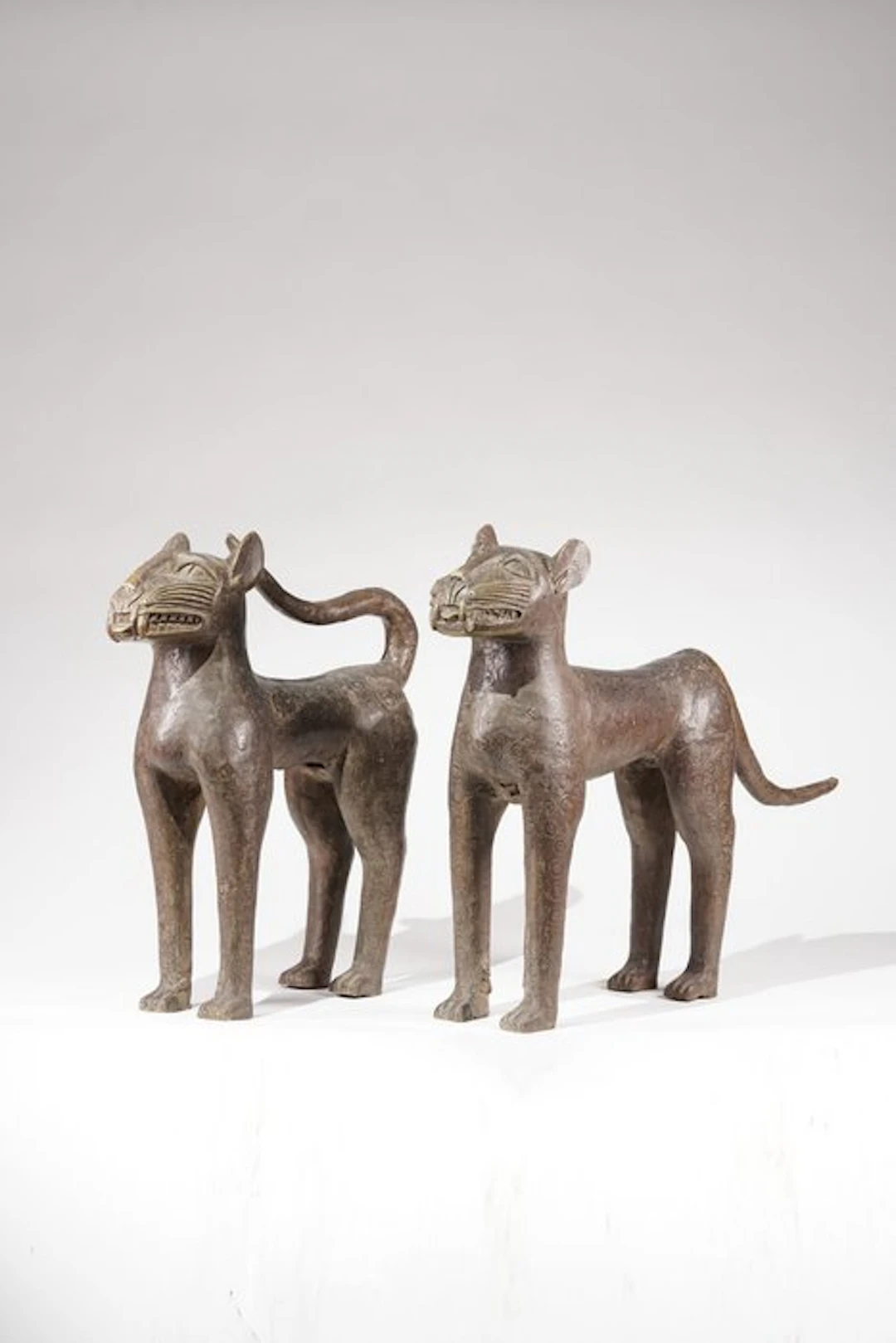
An Impressive Pair of Bronze Leopards In the Style of the Kingdom of Benin, Nigeria Origin: Nigeria, in the style of the Edo culture of the Kingdom of Benin Material: Bronze or copper alloy, cast, with engraved and punched decoration Date: Undetermined Height: 64 and 66 cm Length: 88 and 60 cm Weight: 25.5 and 24 kg Condition: Signs of age and wear, with evidence of earlier, traditionally executed repairs Description An exceptionally imposing pair of bronze leopards, distinguished by their powerful sculptural presence, expressive features, and richly ornamented surfaces. Executed in the style of the celebrated royal metalworking tradition of the historic Kingdom of Benin, in present-day Nigeria, these remarkable sculptures reflect the artistic vocabulary and symbolic significance associated with one of West Africa's most sophisticated courtly traditions. Both leopards are represented standing firmly on four strong, almost columnar legs. Their elongated, muscular bodies combine pronounced formal stylization with an impressive sense of physical strength and dignity. The finely modeled heads, featuring upright ears, almond-shaped eyes, broad muzzles, and open mouths revealing rows of sharply defined teeth, convey an expression of alertness and commanding authority. Particularly striking are the prominently rendered whisker pads, emphasized by parallel incised lines. The surfaces of both animals are extensively decorated with concentric circular motifs and delicate punched markings, creating a highly stylized representation of the leopard's spotted coat. These distinctive patterns are characteristic of leopard imagery associated with the royal artistic traditions of Benin. The two sculptures display subtle yet significant differences in their composition. One leopard has a dramatically curved tail rising above its back, while the other possesses a long, elegantly extended tail sweeping outward behind the body. This variation introduces a lively visual rhythm and lends the pair a dynamic yet harmonious sculptural presence. The dark brown metal surfaces reveal areas of lighter patination, natural irregularities, and visible traces of age. Both figures exhibit evidence of earlier repairs and interventions. Such repairs are of particular interest, as traditional local craftsmen sometimes restored important metal objects using techniques that had already been practiced in precolonial times. Although the exact date of the present repairs cannot be established from visual examination alone, they contribute to the objects' complex material history. Art Historical Context and Symbolism The leopard occupies a central position in the royal iconography of the historic Kingdom of Benin, whose artistic and political achievements reached extraordinary heights particularly between the 15th and 17th centuries. The celebrated Benin Bronzes were produced by highly skilled metalworkers belonging to specialized hereditary guilds serving the royal court. Although commonly referred to as bronzes, these objects were frequently cast in brass and other copper alloys. Within the cultural and spiritual traditions of the Edo people, the leopard symbolized royal power, authority, courage, military strength, and the supernatural nature of kingship. As one of the most formidable predators of the African wilderness, the leopard became closely associated with the Oba, the king of Benin, whose position combined political sovereignty with sacred and ancestral authority. As discussed by the Art Institute of Chicago in its interpretation of The Oba: Leopard of the House (Ekpen N'Owa), the Oba was regarded as a sacred monarch and a living intermediary between the human world and the powerful realm of ancestors and deities. His position transcended the ordinary limitations of human existence, expressing a conception of kingship rooted in both spiritual authority and worldly power. In the metaphorical language of the Benin court, the Oba was known as "the leopard of the house." This designation expressed the close relationship between the sovereign and the animal that ruled the wilderness. Just as the leopard dominated the natural world through strength, cunning, and fearlessness, the Oba exercised supreme authority within the political and spiritual order of the kingdom. The connection was not merely symbolic. Before the British invasion of Benin in 1897, live leopards were reportedly kept within the royal palace, demonstrating the Oba's ability to master and control even the most dangerous creatures of the wild. Leopard imagery was also closely associated with the king's military power, reinforcing his role as protector of the kingdom and supreme commander of its forces. Bronze and brass representations of leopards consequently became important expressions of royal authority. Such sculptures were displayed within palace settings and could serve as ceremonial emblems or participate in ritual contexts associated with kingship and ancestral veneration. Their imposing forms and powerful expressions communicated the majesty and supernatural legitimacy of the Oba. The symbolic importance of these sculptures was further emphasized by the material itself. Brass and other copper alloys, like ivory and coral, were precious materials closely associated with the royal court and historically subject to the king's control. According to Benin court traditions, important elements of the Oba's regalia, including coral crowns, necklaces, garments, and ornaments, were associated with Olokun, the deity of the waters, prosperity, and abundance. Coral, precious stones, ivory, and brass were regarded as materials imbued with spiritual potency, reinforcing the sacred character of royal authority. Despite his exalted status, the Oba's authority was also expressed through the ceremonial support provided by his attendants, who physically assisted him in carrying the weight of his elaborate regalia. This ritual dependence served as a visible reminder of the responsibilities and burdens of kingship. Within this complex symbolic framework, the leopard emerged as one of the most immediate and powerful visual manifestations of royal sovereignty. Stylistic Analysis The present pair of bronze leopards displays several characteristic features associated with the historic sculptural traditions of Benin.Their elongated bodies, strong upright legs, carefully articulated heads, and elaborate surface decoration reflect an artistic approach in which naturalistic observation is combined with an unmistakable tendency toward stylization and symbolic emphasis.The concentric circular markings covering the bodies transform the animals' natural spotted coats into a sophisticated ornamental system. Rather than seeking a purely realistic representation, the sculptors have emphasized the essential qualities of the leopard: physical strength, vigilance, fierceness, and regal composure.The expressive treatment of the heads is particularly noteworthy. The open mouths, clearly defined teeth, deeply modeled facial features, and prominently incised whisker pads create an impression of restrained power. The animals appear simultaneously alert and composed, embodying the controlled strength traditionally associated with the Oba.The almost architectural construction of the bodies, supported by four comparatively straight and substantial legs, further enhances their monumental appearance.Although conceived as a pair, the two figures are not identical. Their differing tail positions and individual variations in modeling suggest an artistic emphasis on complementary forms rather than strict repetition. Seen together, they establish a compelling dialogue between movement and stillness, symmetry and individuality.The combination of substantial dimensions, richly decorated surfaces, and expressive sculptural modeling gives the pair a particularly impressive presence. Condition and Historical Considerations The surfaces display visible signs of age, wear, patination, and areas of earlier repair.Of particular interest are the apparently hand-executed repairs, which may reflect traditional methods of maintaining and preserving valued metal sculptures. Repairs carried out by local craftsmen were known in African metalworking traditions, including during precolonial periods, and were not necessarily considered detrimental to an object's function or significance.In historical contexts, the repair of an important ritual or courtly object could represent the continuation of its social and symbolic life rather than the end of its usefulness.Nevertheless, the presence of such interventions cannot independently establish the age of the sculptures. A precise assessment of their date, casting methods, and restoration history would require closer technical and material examination. Art Historical Appreciation This impressive pair of bronze leopards is a compelling example of the enduring artistic and symbolic legacy of the Kingdom of Benin.Through their powerful stance, highly stylized anatomy, distinctive circular ornamentation, and expressive facial features, the sculptures evoke the visual language of one of the most important royal artistic traditions in sub-Saharan Africa.Their monumental proportions and elaborate surface decoration emphasize the close relationship between artistic craftsmanship, political sovereignty, and spiritual authority.Within the historical context of Benin court art, the leopard was far more than a representation of an animal. It embodied the strength, vigilance, military power, and sacred legitimacy of the Oba, functioning as a visual expression of royal identity.Although the precise dating and workshop attribution of the present pair remain to be established, the sculptures stand firmly within the iconographic tradition of Benin leopard representations.Their striking physical presence, richly decorated surfaces, and individual formal characteristics make them a remarkable pair of sculptures reflecting the enduring importance of the leopard as an emblem of kingship, supernatural authority, and royal prestige. Art Historical Reference The Art Institute of Chicago, The Oba: Leopard of the House (Ekpen N'Owa). Source: The Art Institute of Chicago Some of the information and photos are generated by artificial intelligence and is based on published sources from the fields of ethnography, archaeology, and art history documents. All information and photos are protected by copyright. Inv. No. CAB07313 Sold without TL test. Catawiki's experts perform a virtual review based on the information, photographs, provenance and supporting documentation provided during the submission process. Acceptance of a traditional or ancient African art object for auction does not constitute independent authentication or certification by Catawiki, nor does it mean that Catawiki's expert has physically or scientifically authenticated, patina-analyzed, or dated the object. Under our Terms and Traditional African Art Submission Guidelines, the seller remains responsible for the accuracy, legality, provenance and authenticity of the object and the information provided.
Schätzpreis:€4,000
Zur AuktionAlle Objekte ansehen vonCatawikioderEtnografica
Schätzpreis:
€4,000




Bringen Sie Ihre Auktion zu Sammlern weltweit!
Jetzt eintragen lassenMit der Anmeldung stimmen Sie der Datenschutzrichtlinie zu. Jederzeit abmelden.
Barnebys HQ
Brahegatan 10
BOX 5038
114 37 Stockholm
