



Alle Auktionen / Etnografica / A bronze sculpture - Benin - Nigeria

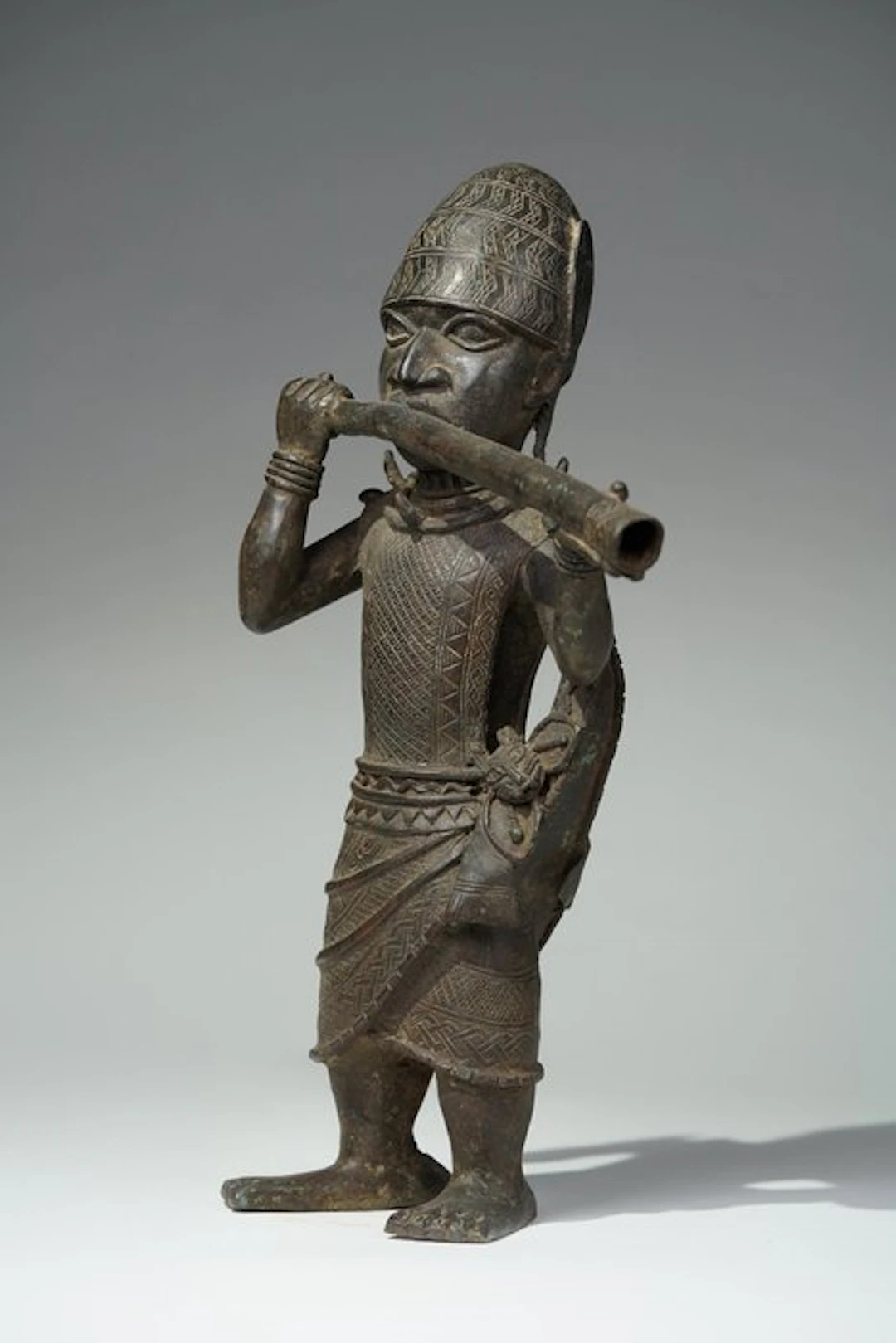
Bronze Sculpture from Benin – Standing Musician with Wind Instrument Origin: Benin City, Edo State, Southern Nigeria Cultural Attribution: Kingdom of Benin, Edo culture Material: Cast copper alloy, traditionally referred to as bronze, dark brown patina with greenish oxidation marks Dating: Not certain Provenance: Benin City region, Nigeria, according to the established provenance Description The richly ornamented metal sculpture depicts an upright musician holding a long, slightly conical wind instrument to his mouth with both hands. The figure has a stocky, powerfully sculpted body with broad shoulders, strong arms, and short, sturdy legs. The comparatively large head is crowned by a tall, domed headdress, the surface of which is entirely covered with finely engraved geometric patterns. Horizontal bands, diagonal lines, and interlocking diamond shapes structure the ornamental design and lend the headdress a remarkable decorative density. The face displays large, almond-shaped eyes with prominently protruding lids, a broad, sculpted nose, and a focused expression. The mouth is partially obscured by an instrument that extends horizontally forward from the face, terminating in an open, slightly widened sound hole. The right hand grasps the instrument directly in front of the mouth, while the left hand supports the front section. Several ring-shaped bracelets adorn the wrists. Around the neck, the figure wears a multi-part ornament, the individual elements of which are sculpted in relief. The torso is covered by a close-fitting, ornamentally structured garment, its surface articulated by fine cross-hatching and geometric bands. A wide belt marks the waist and connects the torso to an elaborately designed sarong, its diagonally draped panels adorned with various patterns. A sculpted accessory, possibly a bag or a piece of ceremonial equipment, hangs from the side. The feet are planted firmly and wide on the ground. The dark brown metal surface shows patches of greenish oxidation, particularly visible on the arms, feet, and in the recesses of the ornamentation. Art Historical Analysis The metalwork of the historical Kingdom of Benin is among the most important courtly art traditions in Africa. The kingdom developed in the area of present-day Edo State and reached a remarkable political and cultural zenith, especially from the 15th century onward. The capital, Benin City, formed the center of a highly developed courtly culture, whose artistic production was closely linked to the institution of the monarchy. Specialized metal casters held a prominent position, their workshops operating under royal control and developing extraordinary technical and artistic mastery. Figurative objects made of copper alloys were often produced using the lost-wax casting process, which allowed for the creation of complex sculptural forms and the finest ornamental details. Benin's courtly art encompasses commemorative heads, relief panels, altarpieces, and figurative representations of dignitaries, warriors, musicians, and other members of the royal entourage. Within this artistic tradition, musicians hold a special significance, as musical performances were closely linked to public ceremonies, courtly processions, and the representation of political authority. The present object incorporates several characteristic design elements of Benin art, including the nuanced depiction of courtly attire, the emphasis on jewelry and attributes of rank, and the meticulous rendering of physiognomy. The tall, ornamented headdress and the richly decorated garment lend the figure a distinguished social presence. Whether the sculpture was actually created within a historical royal workshop or represents a later work in the Benin casting tradition cannot be determined from the photograph alone. Therefore, further investigation is required for a definitive dating and stylistic classification. Iconography and Symbolism The depiction of a musician with a long wind instrument points to the special role of musical performances within Benin's courtly culture. Drums, bells, rattles, horns, and other instruments could be used in ceremonies, processions, and public appearances of the king. Their significance was not limited to musical accompaniment but was often linked to the representation of social order and political dignity. The elongated, conical shape of the instrument is reminiscent of a trumpet or a trumpet-like wind instrument. A precise identification of the instrument is not possible based on the illustration. In Beninese courtly imagery, certain instruments could be associated with specialized musicians and ceremonial functions. The figure's concentrated posture, holding the instrument to its mouth with both hands, conveys the impression of an immediate musical performance. Unlike purely representational standing figures, this depicts a specific moment of physical activity. The richly ornamented clothing could indicate membership in a particular courtly milieu. The headdress, neck and arm ornaments, as well as the differentiated garments, underscore the social significance of the depicted person. However, a definitive identification of their rank or institutional function is not possible. The ornamental density of the sculpture is particularly noteworthy. The geometric patterns not only structure the surface but also emphasize individual body parts and articles of clothing. This creates a visual connection between the human form, social representation, and masterful craftsmanship. Ritual Function and Courtly Context In the historical Kingdom of Benin, music held a central significance for the ceremonial display of royal power. Public appearances by the Oba, religious celebrations, and certain courtly rituals could be accompanied by specialized musicians whose instruments and musical duties were integrated into the institutional order of the court. The depiction of a wind instrument player could therefore point to such a ceremonial context. Especially in the context of royal processions and representative events, musical performances served to make the presence and authority of the ruler publicly perceptible. The commemoration of historical events and the preservation of dynastic traditions could also be linked to musical expression. However, for the present sculpture, it has not been proven that it was originally used as part of a royal altar, court furnishings, or other ceremonial ensemble. It is equally possible that it was created as a representative art object or as a later interpretation of historical Benin motifs. The elaborate design suggests a particular aesthetic and symbolic appreciation of the depicted musician figure, but does not allow for a definitive determination of its original location. Even the visible traces of oxidation provide no reliable clues as to its age or a specific ritual use. Art Historical Assessment The exceptional artistic quality of this bronze sculpture lies in the combination of a powerful, cohesive form with an extraordinarily sophisticated ornamental detailing. The figure possesses a stable, almost monumental presence, reinforced by its widely stance and compact build. At the same time, the angled arms and the horizontally forward-facing wind instrument create a dynamic movement that breaks the strict verticality of the standing figure. The relationship between the large volumes of the body and the finely engraved patterns of the clothing is particularly striking. The ornamental structures follow the sculptural forms, lending them an additional rhythmic articulation. The tall headdress forms a distinctive upper section and enhances the figure's commanding presence. The meticulous modeling of the face conveys a concentrated, serene presence, while the position of the hands and the instrument suggests a specific action. The dark, patinated metal surface with its greenish oxidation zones underscores the composition's three-dimensional depth and makes the fine engravings stand out clearly. Subject to chronological and workshop-historical classification, the sculpture can be considered a remarkable example of figurative metalwork in the tradition of the Kingdom of Benin. Its particular art-historical significance lies in the vivid combination of musical representation, courtly symbolism, and technical sophistication. It illustrates the close relationship between art, social order, and ceremonial culture that is characteristic of historical Benin sculpture. Literature Barbara Plankensteiner (ed.): Benin: Kings and Rituals. Court Arts from Nigeria. Ghent: Snoeck, 2007. Paula Ben-Amos: The Art of Benin. London: Thames & Hudson, 1980. Kathleen Bickford Berzock (ed.): Benin: Royal Arts of a West African Kingdom. Chicago: The Art Institute of Chicago, 2008. The publications mentioned serve to provide a general art historical context for Benin's courtly metalwork. A direct correlation between the present sculpture and any published historical reference work has not yet been established. Copyright and Scientific Documentation Some of the information and photographs have been generated with the assistance of artificial intelligence and are based on published sources in ethnography, archaeology, and art history. Original texts and photographs may be protected by copyright. All rights held by the respective copyright holders are reserved. Inv. No. MAZ32076 Sold without TL test. Catawiki's experts perform a virtual review based on the information, photographs, provenance and supporting documentation provided during the submission process. Acceptance of a traditional or ancient African art object for auction does not constitute independent authentication or certification by Catawiki, nor does it mean that Catawiki's expert has physically or scientifically authenticated, patina-analyzed, or dated the object. Under our Terms and Traditional African Art Submission Guidelines, the seller remains responsible for the accuracy, legality, provenance and authenticity of the object and the information provided.
Schätzpreis:€2,000
Zur AuktionAlle Objekte ansehen vonCatawikioderEtnografica
Schätzpreis:
€2,000




Bringen Sie Ihre Auktion zu Sammlern weltweit!
Jetzt eintragen lassenMit der Anmeldung stimmen Sie der Datenschutzrichtlinie zu. Jederzeit abmelden.
Barnebys HQ
Brahegatan 10
BOX 5038
114 37 Stockholm
