




Alle Auktionen / Etnografica / A bronze sculpture - Ekiti - Nigeria (No reserve price)

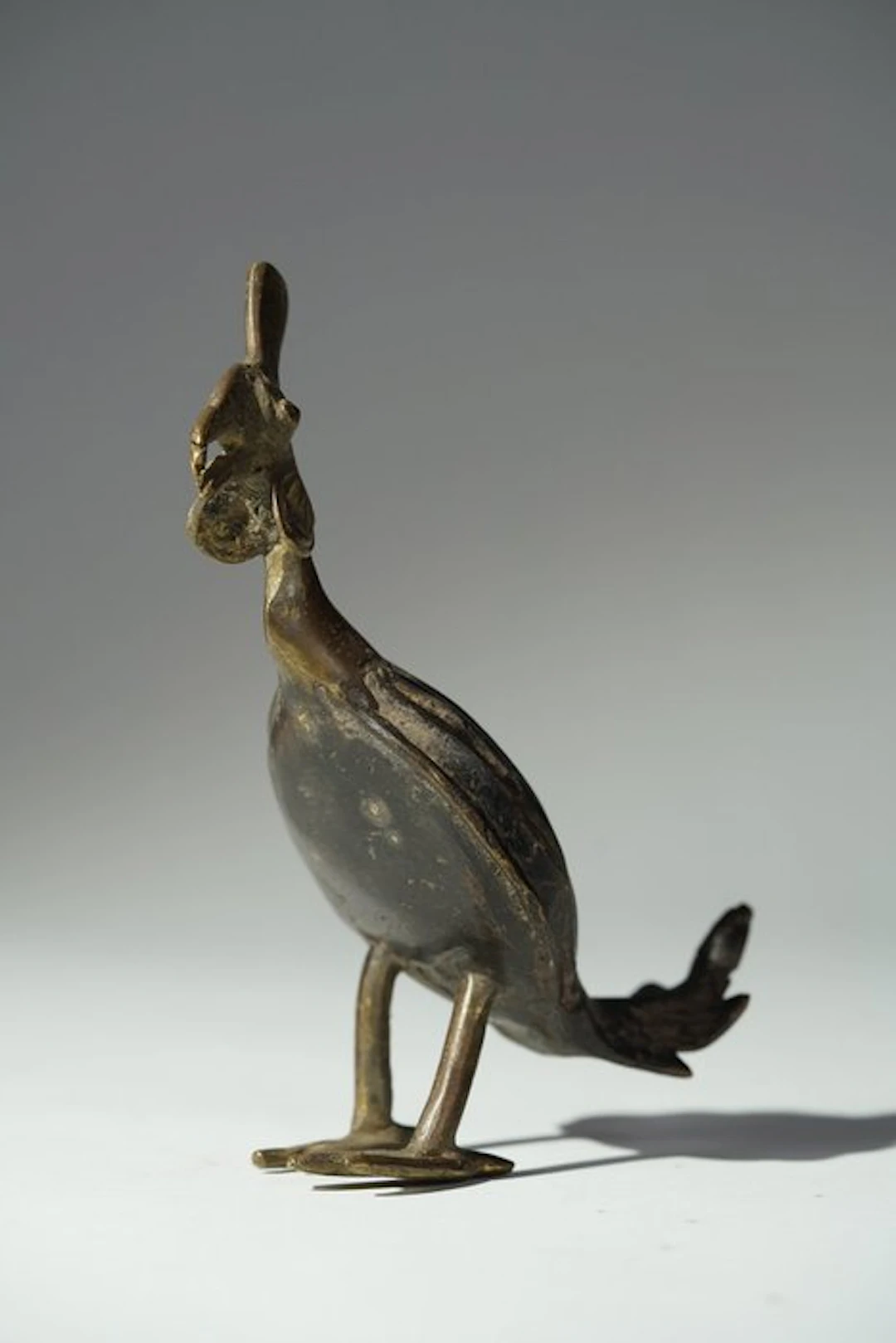
Ekiti Bronze Guinea Fowl, Ebu Village, Asaba Region, Nigeria Ekiti attribution, Ebu village, Asaba region, Nigeria Cast copper alloy This elegant copper-alloy sculpture represents a guinea fowl, recognizable by its compact body, long legs, relatively small head and distinctive upright cranial projection. The bird has been reduced to a remarkably economical sculptural vocabulary, yet its essential character remains immediately legible. The elongated neck, swelling body and animated tail create a strong silhouette, while the narrow legs give the comparatively massive body an impression of alertness and lightness. The head is particularly expressive. A tall, vertically projecting crest rises prominently above it, while small modeled elements articulate the face and sides of the head. The beak projects forward and downward in a pronounced curve. Beneath it, additional rounded forms suggest the wattles characteristic of the guinea fowl. Rather than pursuing strict ornithological naturalism, the caster has selected and amplified those features that make the bird recognizable. The neck forms an elegant transition between the small head and the broad body. Its subtle curvature gives the sculpture a sense of upward movement, reinforced by the erect head and crest. The body itself is conceived as a smooth, compressed oval volume. This simplicity is contrasted by narrow raised and incised passages along the wings, which indicate plumage without covering the entire surface with feather patterns. At the rear, the tail divides into several projecting elements. These flare outward and upward, providing an effective counterweight to the head and neck. The resulting profile is particularly successful: the vertical thrust of the head is balanced by the horizontal movement of the tail, while the rounded body occupies the visual center. Two long, slender legs descend from the body and terminate in extended feet. Their simplified construction emphasizes the essential geometry of the bird rather than anatomical detail. The relative delicacy of these legs is also technically noteworthy, since such projecting elements require considerable control in lost-wax casting. The surface ranges from deep brown to nearly black, with warmer metallic passages appearing along projecting areas and edges. Small areas of greenish oxidation are visible, consistent with a copper-alloy composition. The irregularities and tonal variations of the surface contribute significantly to the sculpture's character, emphasizing the contrast between the broad body and the more finely modeled extremities. Regional characteristics The supplied attribution combines “Ekiti” with Ebu village in the Asaba region. This deserves some qualification. Ekiti is principally associated with the northeastern Yoruba-speaking area considerably farther west, whereas Asaba and its surrounding communities belong to the culturally complex western Niger region of present-day Delta State. Ebu itself lies within this wider area of interaction. For this reason, “Ekiti” should be retained as the recorded attribution rather than interpreted automatically as a conventional Ekiti-Yoruba stylistic classification. The middle and lower Niger regions have historically been characterized by extensive movement of people, objects, metals and artistic technologies. Edo, Igbo, Yoruba and other cultural spheres interacted across these networks, making rigid stylistic boundaries particularly problematic for undocumented metal objects. Animal imagery occupies an important place in the arts of southern Nigeria. Birds can appear in courtly, domestic, commemorative and ritual contexts, and individual species may acquire different associations according to locality and circumstances. The guinea fowl is especially recognizable through its distinctive bodily form and has long been familiar as both a domestic and hunted bird across West Africa. Its cultural significance should nevertheless not be reduced to a single universal symbolism. Depending upon context, birds may participate in ideas concerning prestige, sacrifice, abundance, communication with spiritual forces or proverbial knowledge. Without documentation concerning the original ownership and use of this particular sculpture, assigning it a specific ritual meaning would be speculative. The sculptor's treatment of the bird is especially interesting because it differs fundamentally from the dense ornamental approach encountered on many anthropomorphic copper-alloy figures from southern Nigeria. Here the broad body is deliberately restrained. Surface decoration is concentrated around the wings and head, allowing the smooth convex volume of the torso to dominate. This economy gives the work an unusually modern sculptural presence. Seen in profile, almost every component contributes to the overall contour: the vertical crest, curved beak, narrow neck, elliptical body, raised tail and long legs form a continuous rhythmic sequence. The bird is therefore convincing not because of minute naturalistic detail but because its characteristic posture has been distilled into a few strongly articulated forms. The identification as a pintade—guinea fowl—is consistent with the visible morphology, particularly the upright head ornament, wattled facial structure and compact galliform body. At the same time, the work demonstrates how an observed animal could be transformed through casting into an emblematic sculptural image. Within the supplied Ebu/Asaba context, the piece is particularly valuable as evidence of the diversity of regional copper-alloy traditions beyond the much better documented royal casting centers. Its combination of technical simplicity, confident modeling and highly recognizable silhouette gives the sculpture considerable individuality. Selected Literature Drewal, Henry John, John Pemberton III and Rowland Abiodun. Yoruba: Nine Centuries of African Art and Thought. New York: Center for African Art, 1989. Abiodun, Rowland. Yoruba Art and Language: Seeking the African in African Art. Cambridge: Cambridge University Press, 2014. Berns, Marla C., Richard Fardon and Sidney Littlefield Kasfir, eds. Central Nigeria Unmasked: Arts of the Benue River Valley. Los Angeles: Fowler Museum at UCLA, 2011. Cole, Herbert M., and Chike C. Aniakor. Igbo Arts: Community and Cosmos. Los Angeles: Museum of Cultural History, University of California, Los Angeles, 1984. Some of the information and photos are generated by artificial intelligence and is based on published sources from the fields of ethnography, archaeology, and art history documents. All information and photos are protected by copyright. Inv. No. MAZ31092 Informant: Amadou Dogo
Schätzpreis:€150
Zur AuktionAlle Objekte ansehen vonCatawikioderEtnografica
Schätzpreis:
€150




Bringen Sie Ihre Auktion zu Sammlern weltweit!
Jetzt eintragen lassenMit der Anmeldung stimmen Sie der Datenschutzrichtlinie zu. Jederzeit abmelden.
Barnebys HQ
Brahegatan 10
BOX 5038
114 37 Stockholm
