



Alle Auktionen / Etnografica / A iron sculpture - Vere - Nigeria (No reserve price)

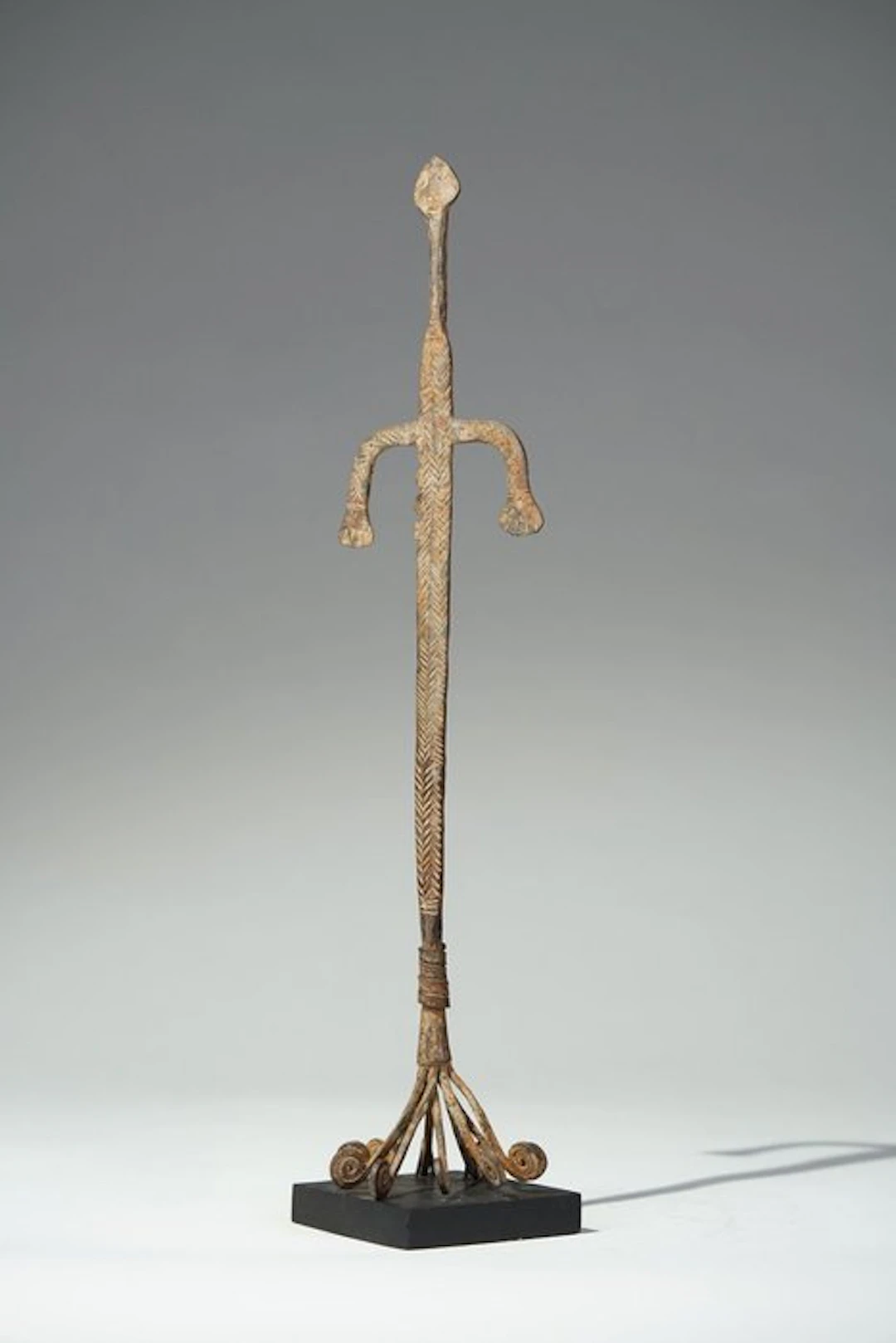
Anthropomorphic iron sculpture of the Vere people – Rod-shaped figure with outstretched arms and a spiral base Origin: Gudusu Village, Jimeta Region, Adamawa State, Northeast Nigeria Cultural Attribution: Vere (Verre), attributed Material: Wrought iron, partially engraved or chased, brown to ochre-colored oxidation patina, incl stand. Dating: Not certain Provenance: Gudusu Village, Jimeta Region, Nigeria, according to the original provenance information Description This exceptionally slender iron sculpture depicts a strictly frontal, anthropomorphically interpretable figure whose body is developed from a long, almost straight central rod. The composition is characterized by a pronounced vertical orientation, symmetrically outstretched arms, and an artfully crafted lower section. The upper part is formed by a narrow, elongated neck or extension that terminates in a small, leaf- or lanceolate-shaped finial. This figure has a slightly pointed contour and an irregularly textured surface. Below the elongated upper section, two arms extend laterally, curving downwards in an arc. Their ends are flattened and widened, resembling highly stylized hands. The arms form an almost mirror-image arrangement, giving the figure a characteristic, cross-like silhouette. The central shaft is covered for much of its length with a meticulously crafted herringbone or woven pattern. The closely spaced diagonal lines create a rhythmic surface texture that can evoke the impression of a textile wrapping or an ornamentally designed covering. In the lower section, the engraved central area is capped by several ring-shaped thickenings or band-like elements. Below this, the shaft widens into a bundle of several narrow iron rods that radiate outwards, some terminating in tightly coiled spirals. These spiral terminations form a decorative yet structurally effective base. The entire surface possesses a differentiated oxidation patina, ranging in color from dark brown and rust red to light ochre. The object is mounted on a modern black display base. Art Historical Analysis The Vere, also known as Verre, are an ethnic group of the eastern Adamawa region, whose historical cultural landscapes extend across parts of northeastern Nigeria and neighboring Cameroon. Their settlements are primarily located in the vicinity of the Atlantika Mountains and the southern Adamawa region. The village of Gudusu is identified as the object's place of origin; however, a more precise attribution to a local workshop or specific craft tradition is not documented. The material culture of the upper Benue and Adamawa regions is characterized by a remarkable diversity of ceramic, wooden, and metal objects. Ironworking, in particular, held significant economic and social importance in numerous societies of this region. The production of forged objects required specialized knowledge of the metal's properties, controlled heating, and plastic shaping through hammering, bending, and joining individual elements. Besides tools and weapons, objects were also created whose design extended beyond immediate practical use. Due to its anthropomorphic basic structure and complex ornamental design, the present sculpture can generally be placed within this broader context. However, its form differs significantly from naturalistically rendered human figures. The body is almost entirely replaced by a narrow central rod, while the arms emerge as independent, laterally extending elements. The lower section, with its spirally curled extensions, forms a strikingly decorative finish. A definitive typological classification within the documented Vere art is not possible based on the photograph. In particular, it remains to be determined whether it is an independent anthropomorphic sculpture, a ceremonial staff object, or a component of an originally larger construction. Symbolism and Iconography The object's iconographic effect stems from the combination of a highly abstracted human figure with geometric and spiral ornamentation. The two outstretched arms are the most prominent anthropomorphic feature. Their symmetrical arrangement could represent a gesture of opening, receiving, or invocation. In various African pictorial traditions, raised or outstretched arms can be associated with notions of communication, protection, or ceremonial action. It is possible to interpret the object in question in this way, but such an interpretation cannot be confirmed without specific ethnographic evidence. The narrow upper extension with its leaf-shaped end could be understood as a highly simplified head, a symbolic crowning element, or an independent symbol. The almost complete absence of facial features and anatomical details is noteworthy. The human figure is thus not depicted as an individual person, but rather reduced to an elemental, almost symbolic structure. The herringbone pattern of the central rod deserves particular attention. Its regular repetition is reminiscent of woven materials, textile structures, or other forms of handcrafted ornamentation. Whether this similarity consciously refers to specific articles of clothing, body markings, or symbolic patterns remains unclear. The spiral ends in the lower section could also have a decorative or symbolic meaning. Spirals appear as independent design elements in various African metalworking traditions, but their meanings cannot be standardized across cultures. In this case, they primarily create a striking contrast to the strictly vertical central axis. These are not the only elements that appear in this object. Ritual Function and Cultural Context Wrought iron objects could fulfill practical, social, and religious functions within various societies of the Adamawa and Upper Benue regions. Their significance was closely linked to the respective local context, their history of manufacture, and their use. The present sculpture possesses several features that suggest a possible ceremonial or representational purpose. These include the anthropomorphic basic structure, the symmetrically outstretched arms, the elaborate surface ornamentation, and the decoratively designed lower section. Its use as a symbol of special social status, as part of a ritual apparatus, or as a symbolic object within a communal context is conceivable. However, reliable information about the original location and specific function is lacking. The spiral extensions could have formed an independent stand or served to secure the object within a larger ensemble. It also remains unclear whether the sculpture was originally freestanding, carried, or attached to another object. The visible oxidation of the iron surface does not allow for a reliable determination of its age and, in itself, does not constitute evidence of ritual use. The anthropomorphic form alone also does not justify a direct interpretation as an ancestral figure, protective figure, or embodiment of a specific spiritual power. A more precise determination of its function therefore requires ethnographically documented comparative objects from the Vere region and additional information on its provenance. Art Historical Assessment The particular aesthetic quality of this iron sculpture lies in the consistent combination of linear reduction, geometric ornamentation, and expansive spatial design. The long central rod forms a clear vertical axis, the strict order of which is rhythmically broken by the laterally curved arms and the spiral elements of the lower section. The figure thus possesses a remarkable tension between static solidity and dynamic movement. The treatment of the surface is particularly impressive. The densely applied herringbone pattern transforms the narrow iron shaft into an ornamentally structured surface, the rhythmic repetition of which further emphasizes the verticality of the composition. The lateral arms form a calm horizontal counterpoint, while the lower spirals create a lively, circular movement. Despite their formal differences, the various design elements appear harmoniously unified. The relationship between material weight and visual lightness is also remarkable. Although iron is a resistant and relatively heavy material, the sculpture appears almost weightless due to its narrow cross-sections and open spaces. The irregular oxidation patina underscores the handcrafted nature of the object and lends it a nuanced material presence. Within the broader art historical context of the metalwork of the Adamawa region, and subject to its cultural attribution, the work can be considered a remarkable example of highly abstracted anthropomorphic iron sculpture. Its particular significance lies in the unique combination of figurative symbolism, ornamental precision, and constructive sophistication. The sculpture impressively demonstrates how a complex sculptural composition can develop from just a few forged elements, its expressiveness arising both from the basic human form and from the rhythmic organization of its lines and ornaments. Literature Marla C. Berns, Richard Fardon, and Sidney Littlefield Kasfir (eds.): Central Nigeria Unmasked: Arts of the Benue River Valley. Los Angeles: Fowler Museum at UCLA, 2011. This publication serves as a general art historical and ethnographic framework for the artistic traditions of the Benue region. For a more precise classification, further research on metalworking and figurative iron art by the Vere people in the Nigerian-Cameroonian border region is needed. Currently, there is no reliable literature reference directly related to this specific type of sculpture. Marla C. Berns, Richard Fardon, and Sidney Littlefield Kasfir (eds.): Central Nigeria Unmasked: Arts of the Benue River Valley. Los Angeles: Fowler Museum at UCLA, 2011. This publication provides a general art historical and ethnographic overview of the artistic traditions of the Benue region. Copyright and Scientific Documentation Some of the information and photographs have been generated with the assistance of artificial intelligence and are based on published sources in ethnography, archaeology, and art history. Original texts and photographs may be protected by copyright. All rights held by the respective rights holders are reserved. Inv. No. MAZ32184 Informant: Amadou Dogo
Schätzpreis:€210
Zur AuktionAlle Objekte ansehen vonCatawikioderEtnografica
Schätzpreis:
€210




Bringen Sie Ihre Auktion zu Sammlern weltweit!
Jetzt eintragen lassenMit der Anmeldung stimmen Sie der Datenschutzrichtlinie zu. Jederzeit abmelden.
Barnebys HQ
Brahegatan 10
BOX 5038
114 37 Stockholm
