




Alle Auktionen / Etnografica / A terracotta sculpture - Cham - Nigeria (No reserve price)

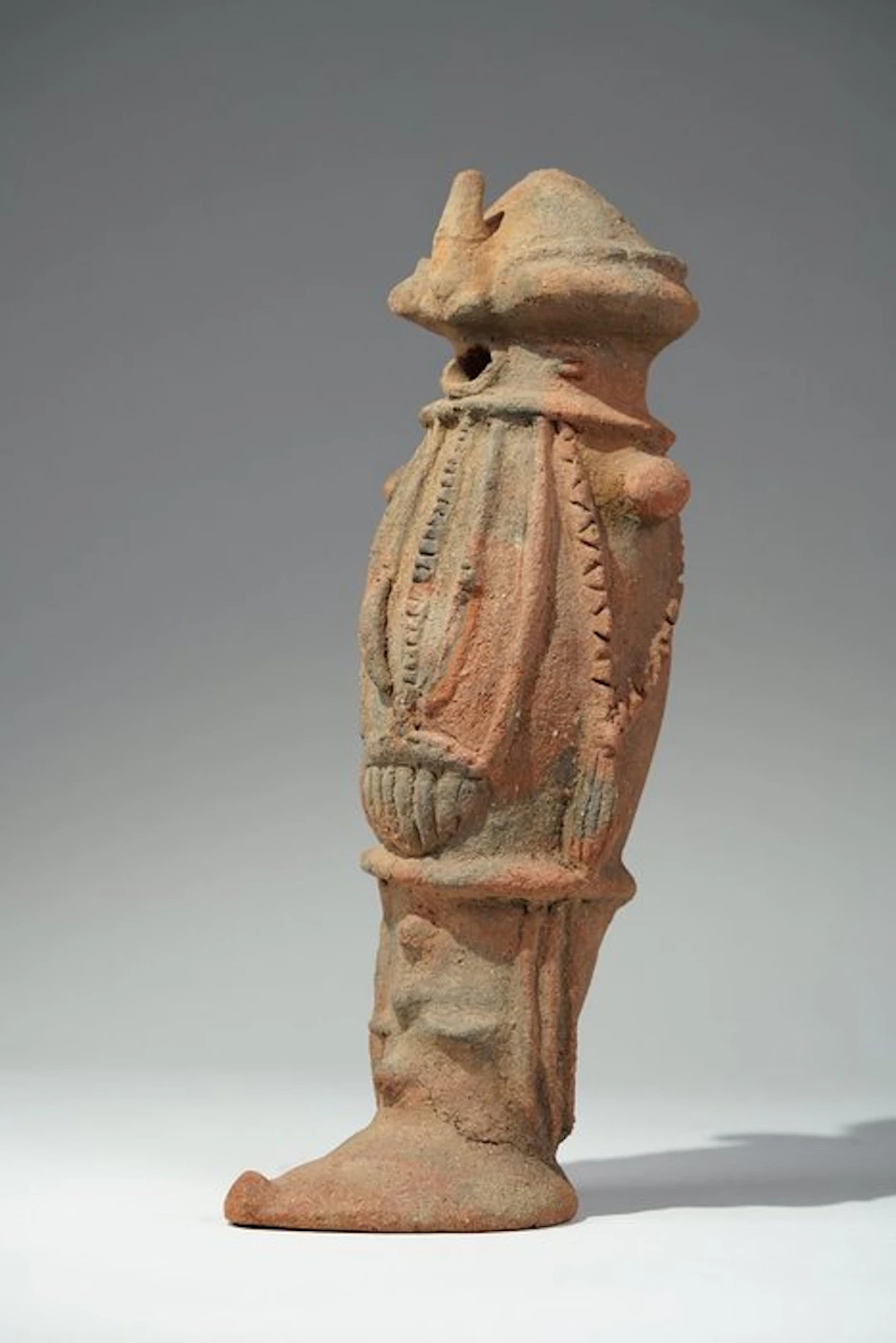
Cham-Longuda Terracotta Sculpture – Anthropomorphic Ritual Vessel with Relief Decoration Origin: Adamawa Region, Northeast Nigeria Cultural Attribution: Cham or Longuda Material: Fired clay, modeled, with sculptural applications, incised and notched decorations, and a reddish-brown to grayish-beige surface patina Dating: Not certain Description This anthropomorphic terracotta vessel from the Adamawa Region in northeastern Nigeria is characterized by an unusual combination of ceramic vessel form, figurative suggestions, and richly detailed sculptural decoration. The tall, nearly cylindrical form rests on a broad, forward-projecting base, the silhouette of which is reminiscent of a highly stylized human foot. Above this rises a narrow, column-like lower section, separated from the more voluminous upper part of the vessel by a strong, horizontal rim. This vessel has a slightly bulbous, upward-tapering shape and is articulated by several vertically running, relief-like ornamental bands. The elongated, partially downward-rounded appliqués are adorned with regularly arranged notches reminiscent of braided cords, textile ribbons, or stylized decorative elements. Smoother, slightly recessed surfaces run between them, creating a rhythmic alternation between the three-dimensionally projecting and recessed zones. At the top, the vessel body is capped by a broad, horizontally projecting shoulder or collar zone. Above this rises a domed, conical finial with a distinctly protruding rim. A small, projecting extension and a laterally visible opening lend this area a particular formal complexity. The opening may originally have served a functional purpose, such as filling or pouring liquids. However, its precise function cannot be determined from the photographic image. The surface has a warm, reddish-brown to ochre hue with grayish-beige deposits and darker discolorations. Numerous small irregularities, abrasions, and partial material losses clearly reveal the handcrafted modeling. Traces of erosion and wear are particularly visible on the ornamental projections and the lower base. Cultural and Geographical Context The Adamawa region in northeastern Nigeria is one of the most culturally diverse landscapes in the Benue Gongola area. Its history is characterized by intensive interactions between different population groups, including the Cham, Longuda, Waja, Tula, and other communities whose settlement areas extend across the present-day states of Adamawa and Gombe and adjacent regions. The Cham and Longuda should be considered culturally and linguistically distinct groups, even though their material traditions may share commonalities through regional exchange. The term Cham-Longuda should therefore not be understood as a definitive ethnic entity, but rather as a preliminary art-historical classification within a broader regional context. The ceramic traditions of this region are particularly well-known, in which vessels were designed not only as functional containers, but also, in some cases, as bearers of religious and social meaning. Anthropomorphic and zoomorphic elements could be combined with conventional vessel forms. The resulting objects often possess a pronounced sculptural quality that transcends their potential practical use. Due to its complex form, its three-dimensional ornamentation, and the suggested human features, the present terracotta piece can be placed within this broader context. However, a definitive attribution to a specific local pottery tradition remains open without documented provenance or reliable comparative objects. Iconography and Symbolism The iconographic design of the vessel is based on a multifaceted combination of anthropomorphic and ornamental elements. The lower base is particularly striking, its forward-reaching form reminiscent of a human foot. Above this, an elongated, leg-like structure develops, supporting the actual vessel body. This design could indicate a deliberate connection between the human form and the ceramic container. The vertical, relief-like ornamental bands of the upper area can also possibly be interpreted as stylized body decorations, jewelry chains, or textile elements. The regular indentations are reminiscent of woven or twisted materials and could refer to specific body shapes. The terracotta is related to ritual objects. In numerous West African societies, jewelry, clothing, and body ornamentation possess a meaning that extends beyond mere decoration. They can express social affiliation, beauty, rank, or special ceremonial roles. However, a direct transfer of such meanings to the present terracotta would be speculative without ethnographic evidence. The wide upper collar and the conical top could have both constructive and symbolic functions. Their design vaguely resembles a headdress or a highly abstracted head, but such an interpretation cannot be definitively confirmed. The combination of the human-like base, the ornamented vessel body, and the complex upper section creates a form that mediates between a human figure and a functional container. Possible Ritual Function Ceramic vessels from northeastern Nigeria could have been used in diverse social and religious contexts. Besides their everyday function as containers for water, food, or other substances, vessels are also known in various regional traditions to have played a role in healing rituals, protective acts, or ceremonies connected with spiritual powers. Anthropomorphically designed ceramics, in particular, can establish a symbolic relationship between the human body and the vessel as a receiving or preserving container. Such an interpretation seems plausible for the terracotta in question due to its unusual design. The visible opening on the side in the upper area could indicate an original use for receiving or dispensing liquids. It could also have functioned as part of a larger ritual apparatus. The elaborately designed surface decorations could underscore the vessel's special significance within its original social context. However, concrete information regarding the circumstances of its discovery, its original location, and traces of use is lacking. Therefore, a definitive classification as a healing, sacrificial, or ancestral vessel would not be justified. The designation "ritual vessel" should be understood as a cautious functional hypothesis, while its actual use remains unclear. Art Historical Analysis From an art historical perspective, the terracotta possesses a remarkable formal independence. Its composition develops from a strictly vertical basic structure, which is articulated by several clearly defined sculptural zones. The broad, foot-like base forms the foundation of a narrow, column-like connection, above which the more voluminous vessel body rises. This body is rhythmically structured by the relief-decorated ornamental bands, thereby acquiring a pronounced surface dynamism. Particularly characteristic is the relationship between the smooth, slightly curved vessel surfaces and the sculpted, regularly notched elements. The ornamentation does not appear as a subsequently added decoration, but rather as an integral component of the overall sculptural design. The vertical bands emphasize the upright orientation of the object, while the horizontal ridges and the wide, projecting upper rim create a counter-movement. This results in a balanced tension between vertical extension and horizontal articulation. The ceramic modeling demonstrates an additive process, in which individual sculptural elements were applied to the base and subsequently differentiated by incisions or notches. This technique allows for a direct connection between the vessel's form and its figurative decoration. Similar principles of combining functional containers with anthropomorphic or ornamental elements are found in the broader context of the terracotta traditions of the Benue Gongola region. However, the present sculpture differs in its unusual base and the highly articulated upper section of the vessel. Its form therefore cannot be readily assigned to a specific, clearly defined type. A more precise art historical classification would require an examination of the reverse side, the vessel's openings, and the manufacturing technique, as well as a comparison with documented regional ceramics. Art Historical Assessment The exceptional artistic quality of this terracotta vessel, attributed to Cham or Longuda, lies in the combination of structural clarity, ornamental diversity, and an unusual anthropomorphic formal language. The sweeping base, the slender lower body, and the richly decorated upper section of the vessel form a complex yet harmoniously structured composition. The relief bands and the regularly incised patterns lend the vessel a distinctive character. The surface displays a rhythmic vibrancy, while the warm, partially eroded terracotta underscores the handcrafted nature of the object. Within the context of the ceramic traditions of northeastern Nigeria, the work illustrates the artistic possibilities of a design in which the boundaries between utilitarian object, human figure, and potential symbol of ritual significance become fluid. The precise dating, original function, and specific cultural attribution remain open to further investigation without additional documentation. It is precisely this combination of formal independence and cultural-historical complexity that makes the terracotta a remarkable testament to regional ceramic sculpture. Literature Marla C. Berns: Art, History, and Gender: Women and Clay in West Africa. Indiana University Press, Bloomington, 1993. Karl-Ferdinand Schaedler: Earth and Ore: 2500 Years of African Art in Terra-Cotta and Metal. Panterra Verlag, Munich, 1997. The publications mentioned serve the general art historical and ethnographic classification of West African ceramic traditions. They do not constitute direct documentation of the vessel in question or a definitive attribution to a specific Cham or Longuda workshop. Copyright and Scientific Documentation Some of the information and photographs have been generated with the assistance of artificial intelligence and are based on published sources in ethnography, archaeology, and art history. Original texts and photographs may be protected by copyright. All rights held by the respective copyright holders are reserved. Inv. No. MAZ31229 Informant: Amadou Dogo Sold without TL test. Catawiki's experts perform a virtual review based on the information, photographs, provenance and supporting documentation provided during the submission process. Acceptance of a traditional or ancient African art object for auction does not constitute independent authentication or certification by Catawiki, nor does it mean that Catawiki's expert has physically or scientifically authenticated, patina-analyzed, or dated the object. Under our Terms and Traditional African Art Submission Guidelines, the seller remains responsible for the accuracy, legality, provenance and authenticity of the object and the information provided.
Schätzpreis:€275
Zur AuktionAlle Objekte ansehen vonCatawikioderEtnografica
Schätzpreis:
€275




Bringen Sie Ihre Auktion zu Sammlern weltweit!
Jetzt eintragen lassenMit der Anmeldung stimmen Sie der Datenschutzrichtlinie zu. Jederzeit abmelden.
Barnebys HQ
Brahegatan 10
BOX 5038
114 37 Stockholm
