




Alle Auktionen / Etnografica / A terracotta sculpture - Djenne - Mali (No reserve price)

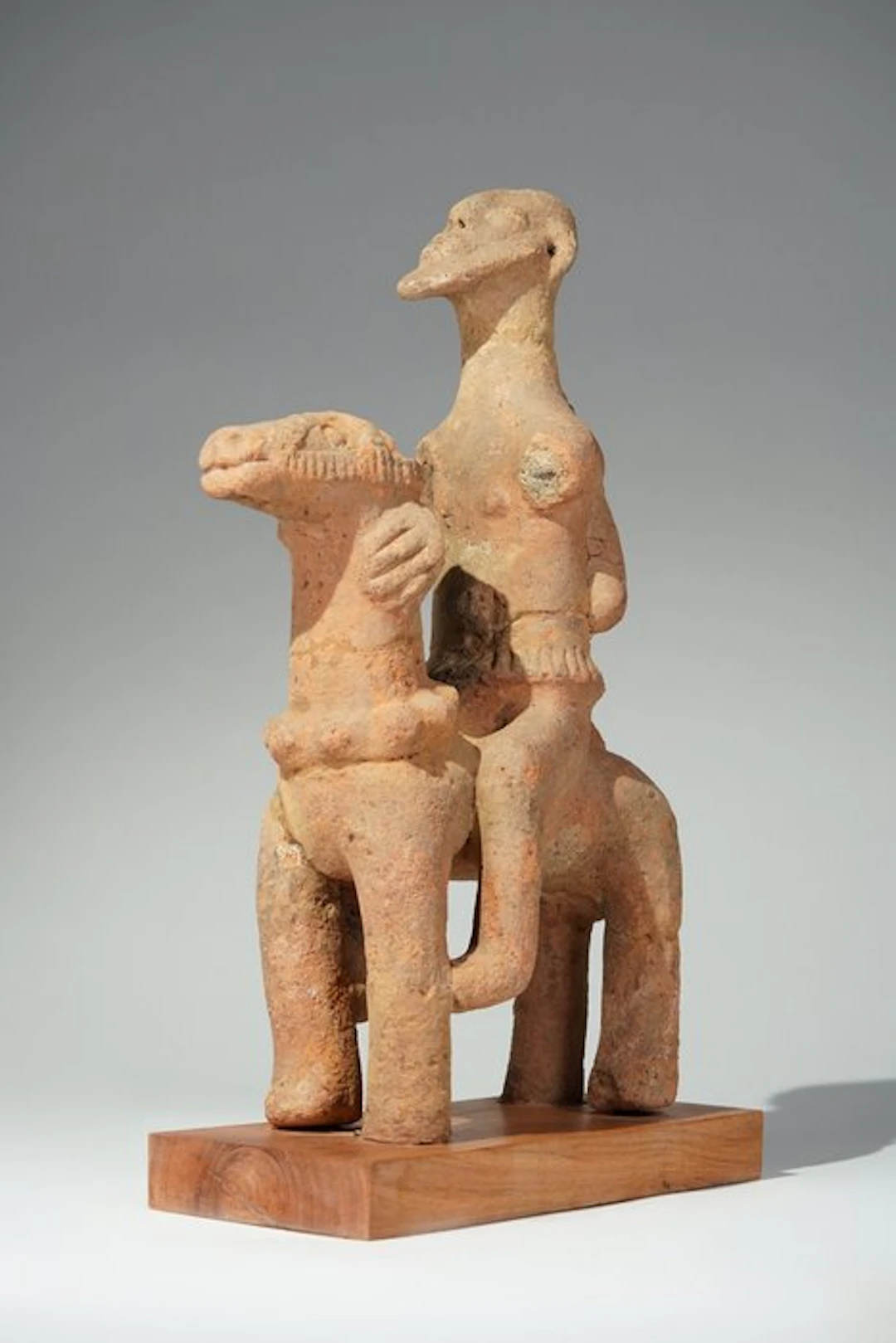
Terracotta equestrian figure, from the tradition of the Inner Niger Delta, known as Djenné, Origin: Mopti region, Mali Material: Terracotta; visible restorations and consolidations, incl stand. Description This terracotta sculpture, known as a Djenné, from the Inner Niger Delta, depicts a figure mounted on a quadruped likely identified as a horse. The composition is vertically oriented, with the rider clearly towering over his mount. The animal has four massive, nearly cylindrical limbs, an elongated body, a neck held high, and a head projected forward. The muzzle is long, the mouth indicated by a horizontal incision, and the eyes are rendered as small circular reliefs. A series of incisions or small notches around the head suggests a mane, a harness, or a decorative motif. The rider has a slender body, a long neck, and a highly stylized head, the lower part of which juts sharply forward. Two small perforations correspond to the nostrils, and lateral reliefs mark the ears. The prominent chest contours could suggest breasts and lead one to consider the figure as a mounted woman, but this identification should be treated with caution until a direct study of the object has confirmed the anatomical characteristics. The figure is seated astride the animal. Her legs extend far down the sides of the mount, and one arm appears to be drawn forward, while the other runs along or meets the back. Transverse incisions around the waist and on certain parts of the limbs may suggest bracelets, a belt, or items of clothing. The modeling prioritizes the clarity of forms and the sculptural unity between rider and animal over anatomical precision. The clay exhibits an overall color ranging from orange-beige to reddish-brown, with some grayer areas. The texture is irregular, dotted with small grains and inclusions, characteristic of a relatively coarse ceramic paste. Several visible signs indicate that the work has had a complex material history. In particular, cracks run through the figure's body; certain areas exhibit differences in color and texture, and several gaps or cavities are visible. On the mount and around the torso, grayish or more uniform areas may correspond to old fillings, consolidations, or restorations. The sculpture now rests on a modern wooden base. However, a photograph does not allow for the definitive distinction between the ancient material and modern additions. For a definitive scientific description, the visual examination would need to be supplemented by an examination under ultraviolet light, X-ray or CT scanning, petrographic analysis of the clay body, and, if necessary, thermoluminescence—a technique commonly used to determine the age of the firing of archaeological terracotta. Historical and Artistic Analysis From a historical and artistic perspective, this work belongs to a remarkable body of terracotta sculptures from the Inner Niger Delta. Archaeological research conducted notably at Djenné-Jeno has established the existence, as early as several centuries before our era, of significant urban communities, with the site reaching its peak of development during the first millennium of our era. The figurative sculptures associated with this region include seated, kneeling, and standing figures, couples, mother-and-child scenes, and horsemen. The Metropolitan Museum highlights the iconographic diversity and the skill of the artists working within this urban civilization of the Middle Niger. Scientific Approach The most significant comparisons involve the large equestrian figures generally dated to the 13th through 15th centuries. The National Museum of African Art, in particular, houses an important sculpture of a horseman from the Inner Niger Delta, over 70 cm tall, dated to the 13th–15th centuries. It illustrates a technique involving hand-molding the clay—sometimes in several assembled pieces—into a paste containing a slip or grog (crushed ceramic fragments), then smoothing the surface and, if desired, applying a red engobe before firing at a relatively low temperature. These parallels support a general attribution to the Middle Niger/Djenné style, but they do not allow for an exact dating of this particular piece without scientific analysis or documented archaeological provenance. The image of the horseman should also be understood as a symbol of prestige. In the medieval Sahel, the horse was a costly animal associated with military mobility, political power, and the elites. Equestrian depictions may therefore represent a warrior, a chieftain, a founding figure, or an ancestral figure. The Smithsonian notes that the clothing and attributes of certain horsemen from the Inner Niger Delta have been interpreted as references to military and ceremonial status. It would nevertheless be unwise to identify this specimen as a specific ruler or an identifiable historical figure. Ritual Function The exact function of the Djenné terracotta figures remains partially unknown, particularly because a large number of examples have been discovered outside their archaeological context. Some controlled excavations have nevertheless shown that the sculptures could have been associated with dwellings or even incorporated into domestic structures. Traditions recorded in the region also mention their preservation in specific spaces where they may have been the subject of veneration. An ancient tradition regarding figures from the Inner Niger Delta links them to deified ancestors or prestigious founders. From this perspective, the horseman may have embodied the prestige, ancestral authority, protection, or memory of a lineage. This interpretation, however, remains a comparative hypothesis: without precise data on the site where this piece was discovered, it is scientifically impossible to attribute a definite individual ritual function to it. Selected Bibliography de Grunne, Bernard. Djenné-Jeno: 1000 Years of Terracotta Statuary in Mali. Brussels: Mercatorfonds, 2014, 399 pp.—a major work that includes, in particular, a section devoted to terracotta horsemen. McIntosh, Susan Keech (ed.). Excavations at Jenné-Jeno, Hambarketolo, and Kaniana (Inland Niger Delta, Mali): The 1981 Season. University of California Press, 1995. McIntosh, Roderick J. and Susan Keech McIntosh. "The Inland Niger Delta before the Empire of Mali: Evidence from Jenne-Jeno," Journal of African History, vol. 22, 1981. National Museum of African Art, Smithsonian Institution. Equestrian Figure, Inland Niger Delta Style, Mali, 13th–15th century. Collection description and technical study. Metropolitan Museum of Art. The Art of Africa: A Resource for Educators, sections devoted to terracotta works from the Inland Niger Delta and to Djenné-Jeno The publications mentioned serve for comparative art historical classification. They do not establish the specific cultural attribution, dating, or original use of the sculpture in question. Copyright and Scientific Documentation Some of the information and photographs have been generated with the assistance of artificial intelligence and are based on published sources in ethnography, archaeology, and art history. Original texts and photographs may be protected by copyright. All rights held by the respective copyright holders are reserved. Inv. No. MAZ33313 Sold without TL test. Catawiki's experts perform a virtual review based on the information, photographs, provenance and supporting documentation provided during the submission process. Acceptance of a traditional or ancient African art object for auction does not constitute independent authentication or certification by Catawiki, nor does it mean that Catawiki's expert has physically or scientifically authenticated, patina-analyzed, or dated the object. Under our Terms and Traditional African Art Submission Guidelines, the seller remains responsible for the accuracy, legality, provenance and authenticity of the object and the information provided.
Schätzpreis:€450
Zur AuktionAlle Objekte ansehen vonCatawikioderEtnografica
Schätzpreis:
€450




Bringen Sie Ihre Auktion zu Sammlern weltweit!
Jetzt eintragen lassenMit der Anmeldung stimmen Sie der Datenschutzrichtlinie zu. Jederzeit abmelden.
Barnebys HQ
Brahegatan 10
BOX 5038
114 37 Stockholm
