



Alle Auktionen / Etnografica / A wooden sculpture - Koussasse - Togo (No reserve price)

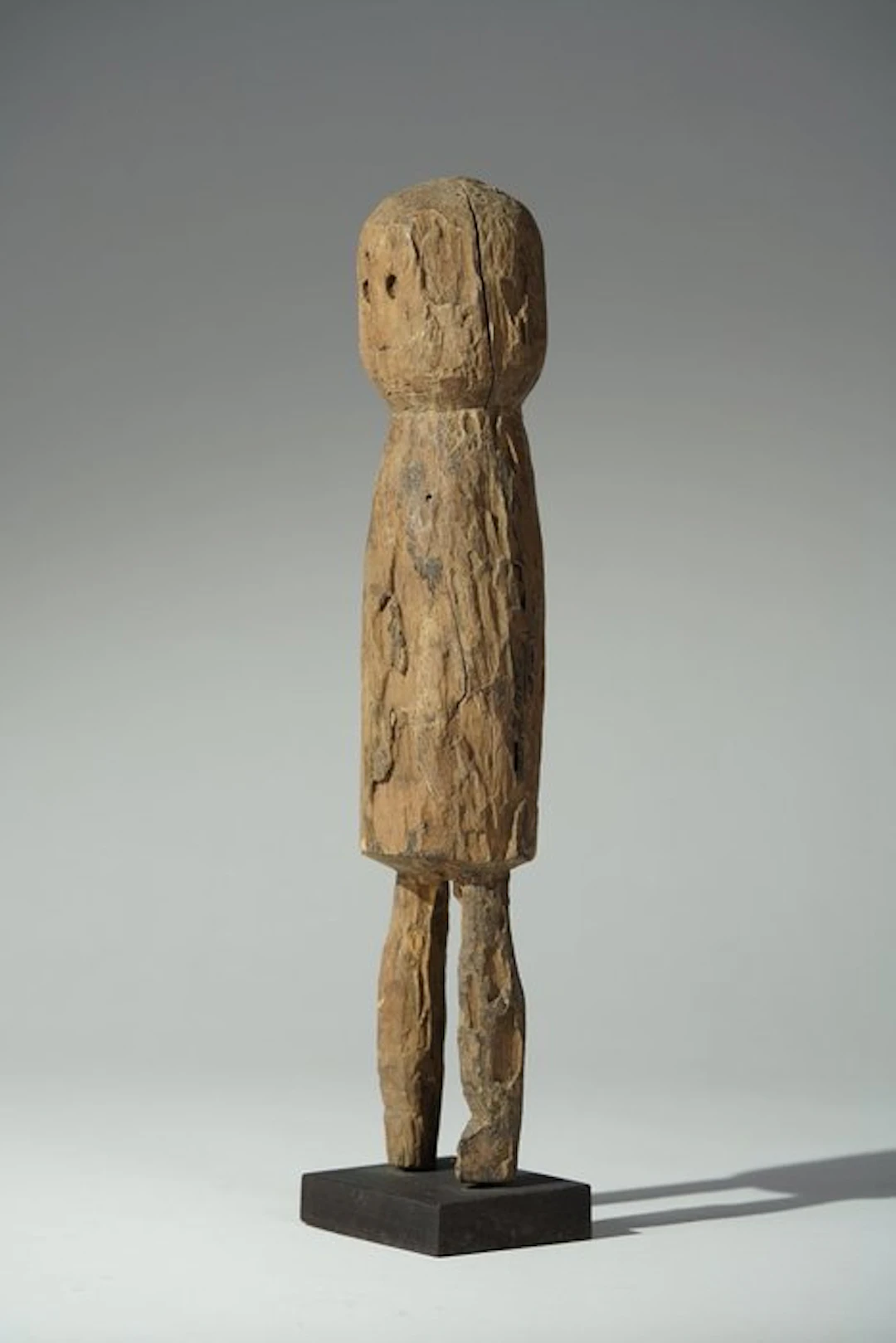
Sculpture Koussasse – Anthropomorphic Ancestor or Guardian Figure Origin: Savannah Region, Northern Togo Cultural Attribution: Koussasse (Kusasi), attributed Material: Wood, carved, with a natural, heavily weathered surface, incl stand. Description This anthropomorphic wooden sculpture from the savannah region of northern Togo is characterized by an exceptionally minimalist design, a strictly vertical body structure, and an impressive surface marked by natural aging processes. The upright figure is carved from a single piece of wood and has a large, nearly spherical head that rests directly on a narrow neck. The face is reduced to a few, sparsely carved features. Two small, sunken eyes mark the front of the head, while the nose and mouth appear barely or indistinctly defined. The smooth, slightly domed forehead transitions into a rounded skullcap, the surface of which is crisscrossed by deep longitudinal cracks. Below the head, an elongated, slightly conical torso develops, its outline reminiscent of a narrow, downward-curving cylinder. Arms, hands, and anatomical details of the upper body are not discernible. Rather, the body forms a closed, sculptural unit, which only dissolves in the lower section into two long, nearly parallel legs. These are separated by a deep gap and end without sculpted feet. The light brown to grayish-brown wooden surface shows pronounced signs of erosion, deep cracks, irregular breaks, and areas of darker discoloration. The vertical wood grain is particularly prominent on the torso and legs. The surface suggests prolonged exposure to climatic influences, although the photographic evidence alone does not allow for the determination of either the duration of these influences or the original display conditions. The current black display base is clearly not part of the original sculptural concept. Cultural and Geographical Context The population groups known as Koussasse or Kusasi are primarily located in northeastern Ghana and adjacent areas of Burkina Faso. The owner's stated origin in the savannah region of northern Togo thus points to a broader West African cultural sphere, whose historical relationships are characterized by migration, trade, and cultural exchange. A definitive attribution of the sculpture to the Kusasi cannot be confirmed based solely on its formal characteristics. Northern Togo is an ethnically and culturally diverse region where, among others, the Moba, Konkomba, Tchokossi, Bimoba, and other communities have developed distinct traditions of figurative wood carving. Particularly in northern Togo and the adjacent regions of Burkina Faso and Ghana, highly abstracted anthropomorphic wooden figures are known, whose meaning is often linked to ancestor worship, familial protection rituals, and the relationship between the living and the dead. In these religious systems, material representations can serve as memorials, objects of protection, or components of cultic installations. Their effectiveness, however, is not necessarily determined by a naturalistic rendering of the human body. Rather, the sculptural presence of a figure can arise from its ritual integration, its placement, and its ascribed relationship to supernatural entities. The present sculpture can be formally placed within this broader context, without this proving a specific original function. Symbolism and Possible Ritual Function The striking simplification of the human form opens up various possibilities for interpretation. The disproportionately large head could allude to a special significance of the head as a bearer of personality, memory, or spiritual identity. In numerous West African traditions, the head holds a prominent symbolic position, but it would be methodologically inadmissible to directly derive a specific religious message for the present figure from this. The missing arms and the largely closed body form lend the representation a decidedly static character. Instead of an acting or gesturing person, a resting, self-contained figure appears. This formal restraint could be compatible with its function as an ancestral representation or protective figure. An original placement within a family cult area, at a shrine, or at another ritually significant site is conceivable. Its use in connection with local earth or ancestor cults can also be considered within a broader regional context. However, ethnographic data that could substantiate such an interpretation for this specific object are lacking. The severe weathering could indicate prolonged exposure to the elements, as is documented for certain ritual wooden figures in the savanna region. Likewise, storage conditions or other subsequent influences could be responsible for its current state of preservation. The designation as an ancestral or protective figure should therefore be understood as a cautious functional hypothesis and not as a definitive classification. Art Historical Analysis The sculpture embodies a consistently abstract conception of the human figure, in which anatomical differentiation recedes in favor of a clear, elemental overall form. Its composition is based on three main sculptural elements: the spherical head, the elongated, slightly conical torso, and the two slender legs. These elements are connected without pronounced transitions and form a strictly vertical unity. The reduction of the face to two small depressions reinforces the impression of a deliberately restrained individualization. The head derives its expressiveness less from physiognomic details than from its size, its closed curve, and its position within the overall composition. The torso appears almost architectural, its form reminiscent of an upright wooden post. This affinity between human representation and the elemental post form can be observed in various sculptural traditions of the West African savannah regions. In particular, the wooden figures of the Moba people in northern Togo offer an important art-historical point of comparison with regard to their simplified conception of the body. The so-called tchitcheri of the Moba are often characterized by simplified human forms, elongated bodies, and a strong emphasis on the vertical axis. Such formal parallels are revealing for comparative analysis but do not justify an automatic reclassification of the present figure. Its cultural origin remains open, considering the traditional name Koussasse and the regional stylistic overlaps. The interplay between the original carving and the current, heavily eroded wooden surface is particularly noteworthy. Deep cracks, eroded areas, and irregular material losses lend the object an additional sculptural texture that partially obscures its original form. The resulting aesthetic effect should not be equated with a demonstrable artistic intention. Art Historical Assessment The particular quality of this sculpture lies in its radical formal concentration. With just a few sculptural interventions, a human figure of remarkable presence emerges. The large, almost closed head, the columnar body, and the slender legs form a composition whose effect derives primarily from proportion, rhythm, and materiality. The heavily weathered surface lends the figure an additional historical dimension, without allowing for a precise dating. In the context of figurative wood carving from the West African savannah belt, the object illustrates an aesthetic approach in which the human form is reduced to its fundamental sculptural characteristics. The figure is thus a striking example of the expressive possibilities of a sculpture whose artistic intensity arises precisely from the renunciation of naturalistic details. Literature Piet Meyer: Art and Religion of the Lobi. Museum Rietberg, Zurich, 1981. As comparative literature on figurative wood sculpture and religious beliefs in the wider West African savanna region. Christopher D. Roy: Art and Life in Africa. University of Iowa, Iowa City, 1992. As a general reference on African sculpture traditions and their cultural functions. The publications mentioned serve for comparative art historical classification. They do not establish the specific cultural attribution, dating, or original use of the sculpture in question. Copyright and Scientific Documentation Some of the information and photographs have been generated with the assistance of artificial intelligence and are based on published sources in ethnography, archaeology, and art history. Original texts and photographs may be protected by copyright. All rights held by the respective copyright holders are reserved. Inv. No. MAZ30880 Informant: Ouro
Schätzpreis:€210
Zur AuktionAlle Objekte ansehen vonCatawikioderEtnografica
Schätzpreis:
€210




Bringen Sie Ihre Auktion zu Sammlern weltweit!
Jetzt eintragen lassenMit der Anmeldung stimmen Sie der Datenschutzrichtlinie zu. Jederzeit abmelden.
Barnebys HQ
Brahegatan 10
BOX 5038
114 37 Stockholm
