
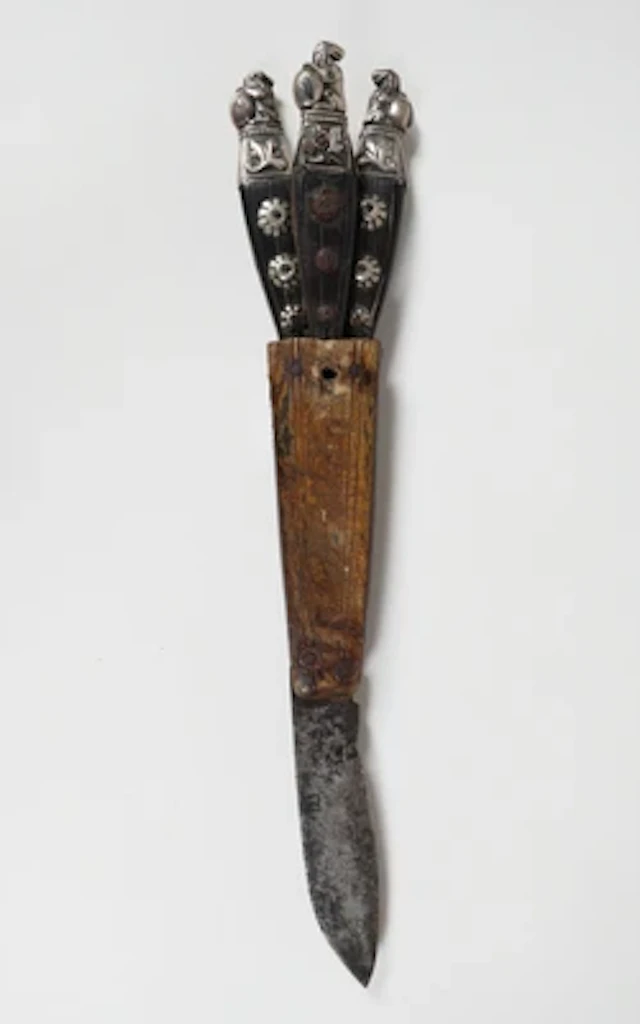
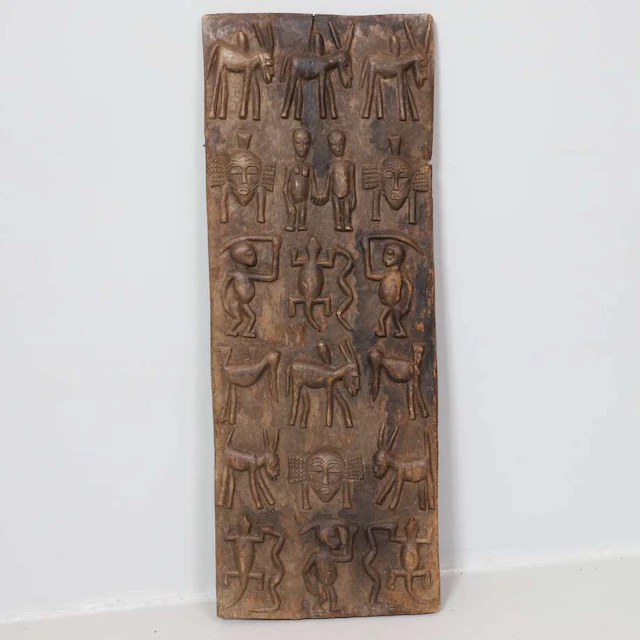



Alle Auktionen / Etnografica / A wooden sculpture - Mianka - Mali (No reserve price)

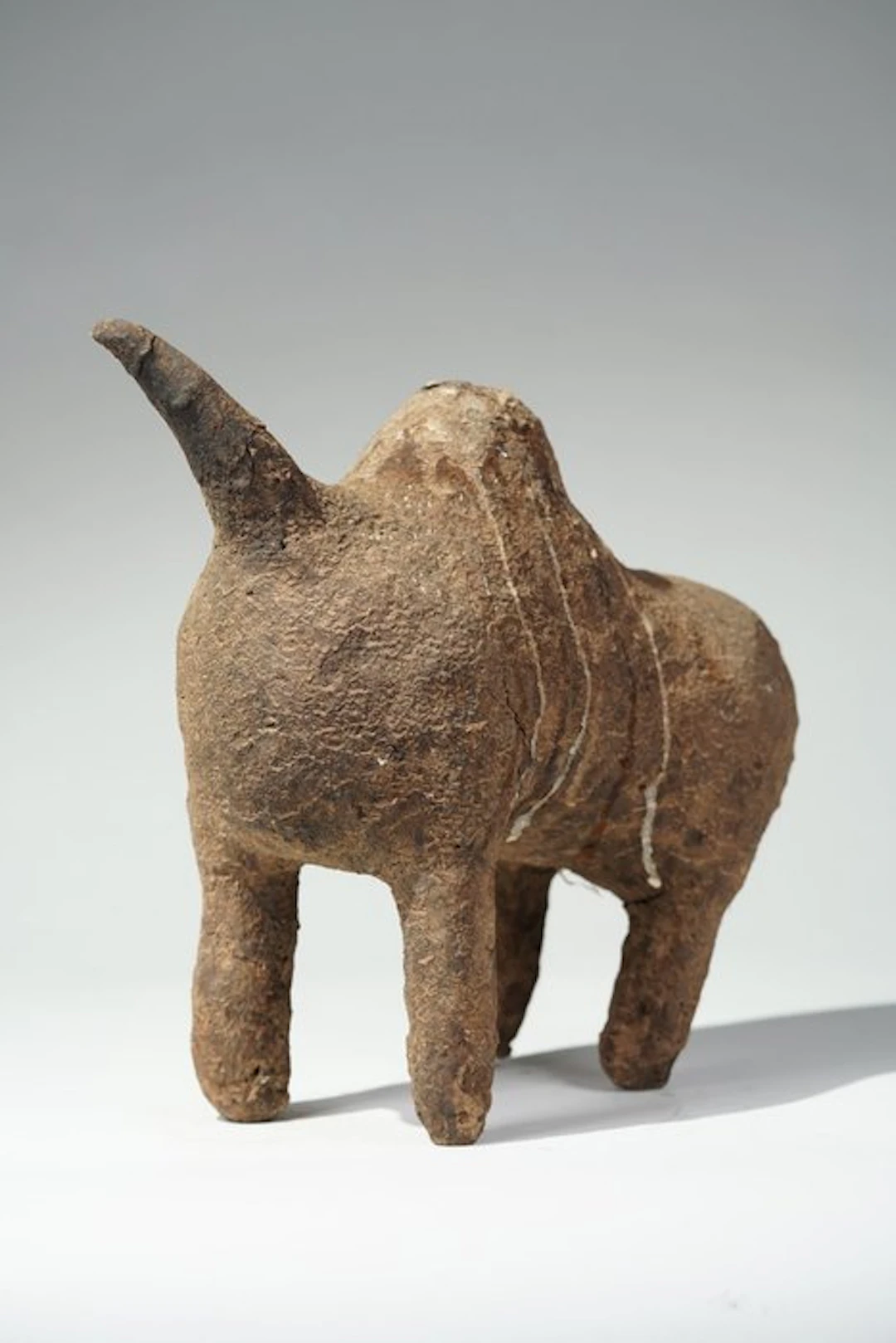
Zoomorphic Minyanka sculpture – Wantchi, four-legged animal figure Origin: Koutiala region, southeastern Mali Cultural affiliation: Minyanka (Minianka), attributed Object name: Wantchi, according to historical records Material: Probably wood with an earthy, encrusted surface coating; precise material identification not certain Dating: Not certain Provenance: Koutiala region, Mali, according to historical records Description This compact, four-legged animal figure is characterized by an unusually closed body shape and a distinctly archaic-looking surface texture. Its squat, almost barrel-shaped torso rests on four short, sturdy legs, whose cylindrical forms taper to bluntly rounded ends without differentiated hooves or paws. The legs are largely unarticulated, giving the body a stable, almost architectural basic structure. The unusual design of the upper body is particularly striking. At one end rises a narrow, obliquely upward-pointing protrusion, which could be interpreted as a neck with a greatly reduced head, a horn, or some other animal attribute. Its slightly curved silhouette forms a striking contrast to the massive torso. In the middle section, a broad, hump-like protrusion rises, its surface crisscrossed by irregular, partially light-colored lines and depressions. The opposite end of the body is rounded and slopes down towards the hind legs. Due to the high degree of abstraction, a definitive identification of the depicted animal species is not possible. The entire sculpture has a rough, dark brown to ochre-colored surface, whose irregular encrustations, fine cracks, and occasional light gray deposits largely obscure the original material structure. The uneven layers and the partially visible grooves, in particular, lend the object a pronounced tactile quality. Art Historical Analysis The Minyanka are one of the ethnic groups of southeastern Mali, particularly those in the regions around Koutiala and the adjacent areas towards Burkina Faso. Their cultural traditions developed within a complex regional context shaped by historical ties to the Bamana, Senufo, and other societies of the West African savanna. The Minyanka's material culture encompasses a wide variety of objects used in everyday life as well as within religious and communal institutions. Of particular significance are the objects associated with various cultic communities, whose design often focuses not on naturalistic representation but on the material embodiment of specific forces and concepts. Within this cultural context, animal representations occupy a special position. They can appear as independent sculptural figures or as components of more complex ritual ensembles. Based on its documented origin and its highly abstracted zoomorphic design, the present sculpture can be fundamentally placed within this broader context. However, their compact body shape and the almost complete reduction of anatomical details distinguish them from more naturalistically rendered animal figures. The term Wantchi is used here according to the surviving object description; its precise local meaning and its classification as a documented Minyanka object type are not yet certain. A more precise art historical classification would therefore require ethnographically documented comparative objects and additional information about the original context of use. Symbolism and Iconography The sculpture's iconographic peculiarity lies in the deliberate simplification of the animal form to a few characteristic physical features. The massive torso, the short legs, and the obliquely erect appendage create a distinctive silhouette without allowing for a clear zoological identification. The hump-like elevation could be reminiscent of a cow or another large mammal. It is also conceivable that the figure represents a composite or deliberately distorted animal. Within various West African cultural traditions, animal figures can symbolize qualities such as strength, fertility, protection, or the connection between the human and non-human worlds. However, such meanings are always tied to specific cultural contexts and cannot be applied indiscriminately to individual objects. For the present figure, a symbolic emphasis on physical strength or resilience would be conceivable, but this interpretation remains hypothetical. Particularly noteworthy is the closed, almost block-like design, which lends the animal a calm yet powerful presence. The unusual form of the body may be intended less to depict a specific animal than to emphasize selected characteristics. The pronounced surface texture also contributes significantly to the iconographic effect. It overlays the original form and makes the sculpture appear as an object whose meaning may lie not only in its figurative representation but also in its material composition. Ritual Function and Cultural Context In the religious life of the Minyanka, various cult communities and the relationships between people, ancestral beliefs, and supernatural forces have historically played a significant role. Particularly in connection with certain protective and sacrificial rites, material objects can acquire special significance through repeated actions, offerings, and the application of various substances. The ritual efficacy of such objects is not necessarily tied to a naturalistic representation within the respective local belief systems. Rather, the combination of a highly abstracted form with a surface altered over time can significantly contribute to its cultural significance. The animal figurine exhibits a strikingly thick, irregular surface coating, suggesting repeated treatments with earthy or other organic and mineral substances. Such an interpretation would be consistent with certain West African ritual practices, but cannot be confirmed based on the photograph. Likewise, the encrustations could have resulted from natural aging processes, soil storage, or subsequent surface alterations. A definitive distinction is not possible without material analysis. If the object was indeed used within a ritual context, its zoomorphic form may have served a symbolic or protective function. However, the precise meaning of the traditional name "Wantchi," as well as any possible connection to specific local religious communities, remains unclear. Art Historical Assessment The unique aesthetic quality of this animal figurine lies in its radical formal density. The body appears as an almost completely sculptural mass, its volume articulated only by the four short legs and the few protruding elements. The sculpture achieves its effect not through anatomical precision or ornamental detailing, but through the balanced relationship between mass, silhouette, and surface texture. The short, sturdy legs lend the object a pronounced stability, while the obliquely erect appendage introduces a subtle movement into the otherwise tranquil composition. The contrast between the rounded body volumes and the rough, irregularly encrusted surface is particularly striking. The lighter deposits and darker depressions create a differentiated texture that reflects light unevenly and enhances the figure's physical presence. The hump-like elevation forms a prominent sculptural focal point and lends the silhouette a characteristic tension. Within the broader art historical context of zoomorphic sculpture from southeastern Mali, and subject to its cultural and functional classification, the object can be considered a remarkable example of a highly abstract representation of an animal. Its particular significance lies in the combination of elementary sculptural forms with a materially complex surface. It is precisely this concentration on a few essential design elements that lends the sculpture its distinctive expressiveness and makes it an interesting testament to the diverse visual traditions of the West African savanna. Literature Jean-Paul Colleyn: Les chemins de Nya. Culte de possession au Mali. Paris: Éditions de l’École des hautes études en sciences sociales, 1988. The aforementioned study provides an ethnographic background to the religious traditions of the Minyanka. A directly established art historical reference to the figure type known as the Wantchi is lacking. In particular, the local terminology, the identification of materials, and the original function require further investigation. Copyright and Scientific Documentation Some of the information and photographs have been generated with the assistance of artificial intelligence and are based on published sources in ethnography, archaeology, and art history. Original texts and photographs may be protected by copyright. All rights held by the respective rights holders are reserved. Inv. No. MAZ32153 Informant: Petit Coulibaly
Schätzpreis:€450
Zur AuktionAlle Objekte ansehen vonCatawikioderEtnografica
Schätzpreis:
€450




Bringen Sie Ihre Auktion zu Sammlern weltweit!
Jetzt eintragen lassenMit der Anmeldung stimmen Sie der Datenschutzrichtlinie zu. Jederzeit abmelden.
Barnebys HQ
Brahegatan 10
BOX 5038
114 37 Stockholm
