




Alle Auktionen / Etnografica / A wooden sculpture - Moba - Ghana (No reserve price)

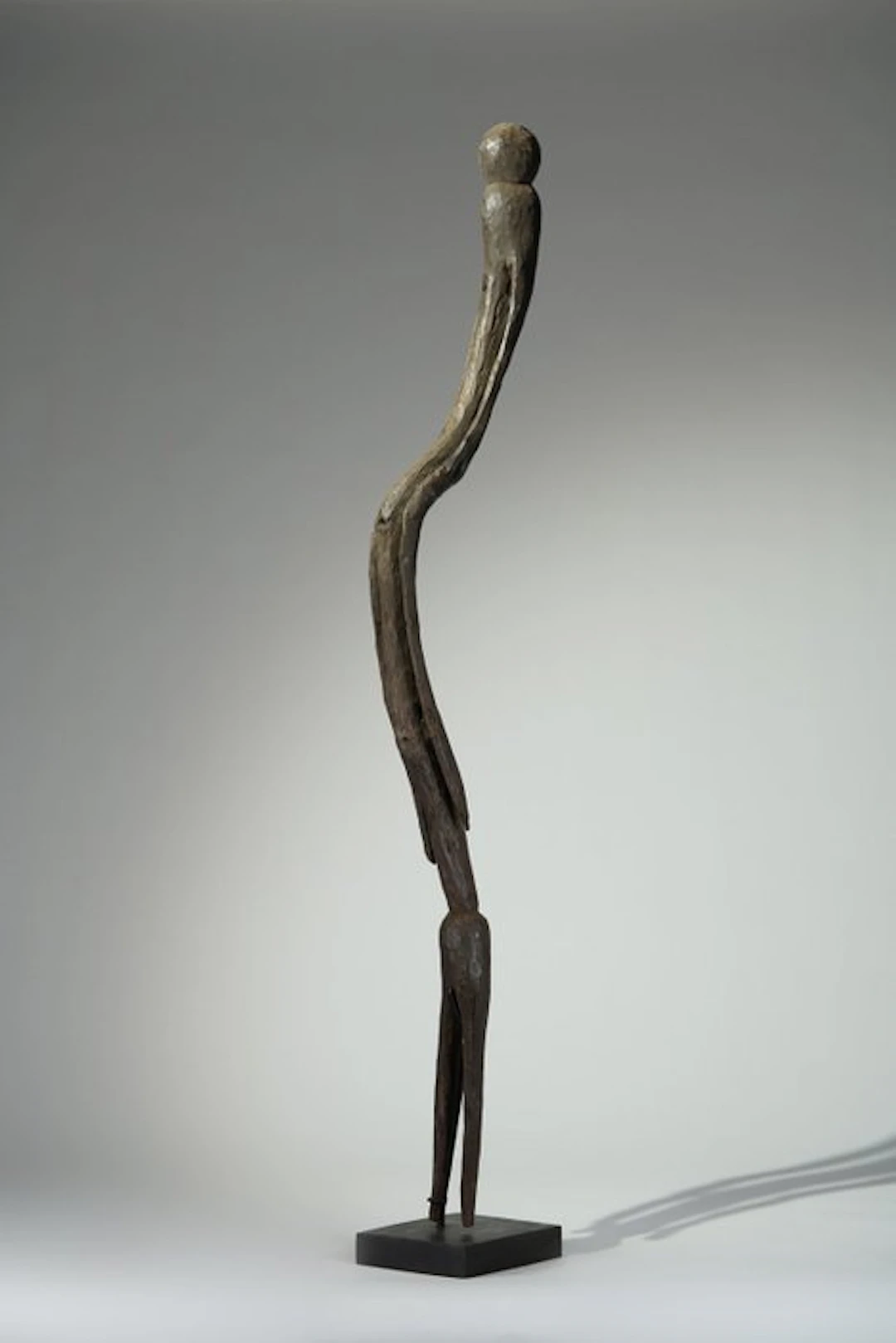
Moba Sculpture (Tchitcheri) - Northern Ghana, incl stand. This exceptionally slender wooden figure is abstracted to the very edge of representation. Two narrow, splayed legs merge into an extremely elongated, gently curved body, whose natural curvature of the wood is deliberately incorporated into the composition. The arms appear merely as elongated, parallel slats. A small, spherical head without discernible features forms the understated crown. Notches, cracks, and a dark gray-brown, irregular surface preserve the traces of carving and aging. This radical reduction lends the figure a quiet, almost calligraphic monumentality. Formally, the work belongs to the Moba tradition, whose settlement area extends across northeastern Ghana and northwestern Togo. Characteristic of this tradition are the tchitcheri: highly abstracted human figures carved from a single piece of wood, created at the behest of a diviner for personal, family, or communal shrines. Size and placement significantly determined their function: Large tchitcheri sakab could represent ancient clan ancestors and were set deep into the ground; medium-sized figures were more likely to be found in family shrine contexts. Without measurements or a confirmed provenance, the present figure cannot be definitively assigned to either of these categories. Literature (selection) Christine Mullen Kreamer: “Moba Shrine Figures”, African Arts 20/2, 1987, pp. 52–55, 82–83. AfricaBib Christine Mullen Kreamer: “Seeing Between Worlds: A Moba Figure”, in: Frederick Lamp (ed.), See the Music, Hear the Dance, Munich 2004. Pacific Lutheran University THE PHOTO Between Aestheticization and Appropriation – The Tchitcheri through the Western Gaze The photograph stages an encounter between two very different aesthetic and cultural orders. At its center, a cellist sits within a decaying, apparently European interior. The dramatic black-and-white composition, the long white dress, monumental mirror, streaming light, and billowing curtains create a romantic, melancholic, almost theatrical atmosphere. To the left stands an extremely slender, elongated wooden figure that formally recalls the tchitcheri of the Moba from northern Ghana and neighboring Togo described in the ethnological text. Its narrow, splayed legs, dramatically elongated body, reduced arms, and small spherical head correspond to the radical abstraction characteristic of this sculptural tradition. Yet this juxtaposition is deeply ambivalent. The ethnological text makes clear that a tchitcheri was not originally conceived simply as an autonomous “sculpture.” Such figures were created at the request of a diviner and belonged to specific personal, familial, or communal shrine contexts. Size, placement, and location were integral to their meaning. Large tchitcheri sakab, for example, could represent ancient clan ancestors and were planted deeply into the ground. The object was therefore embedded within a social, spiritual, and spatial network of relationships. The photograph performs precisely the transformation that has characterized much of the Western reception of African objects: a relational and ritually situated object becomes an autonomous aesthetic sculpture. The figure is placed on a pedestal, isolated vertically, and brought into dialogue with symbols of European high culture: the cello, classical musical tradition, elegant dress, and historic interior. At first, this may appear to constitute a form of recognition. The African figure is no longer presented as an ethnographic curiosity but as an artwork of equal formal significance. Yet this apparent elevation also contains a postcolonial problem. The autonomous artwork, the pedestal, the white cube, the isolated museum display, and the emphasis on form, dating, provenance, and aesthetic quality are neither neutral nor universal modes of presentation. They have largely emerged from European histories of art and collecting. When a tchitcheri is removed from its original field of relationships and appreciated primarily for its abstraction, formal reduction, or “calligraphic monumentality,” a colonial hierarchy can paradoxically persist precisely where it appears to have been overcome. African objects are granted the status of “art” by being translated into the institutional categories of the Western art system. The photograph makes this tension particularly visible. The cellist acts, performs, and occupies the compositional center. The Moba figure, by contrast, remains a silent and aestheticized counterpart. A blurred human presence also appears in the mirror, introducing a compelling relationship between body, sculpture, memory, and absence. At the same time, the composition can be read critically as a continuation of a Western regime of looking. The African object becomes an atmospheric sign while its original social and spiritual context disappears. Its perceived strangeness and formal radicalism intensify the aesthetic effect of an otherwise distinctly Western-coded setting. This criticism can be extended to contemporary postcolonial museum practices. Many Western museums are now attempting to address colonial histories of acquisition, conduct provenance research, reconsider problematic terminology, and move away from presenting African objects merely as documents of supposedly “primitive” cultures. The problem arises when decolonization amounts primarily to transferring such objects from ethnographic contexts into the aesthetic framework of the art museum. The older hierarchy – in which European institutions retain the authority to determine what an African object is and how it should be seen – may then survive in a more sophisticated and aesthetically appealing form. The contradiction becomes even more pronounced when Western museum and exhibition models are subsequently exported to Africa as supposedly universal standards. White-cube architecture, pedestals, vitrines, art-historical classifications, conservation standards, and the categories of the international art market can certainly contribute productively to African cultural institutions. They become problematic, however, when they displace other ways of engaging with objects or are presented as the only legitimate model of professional museology. This could constitute a new and subtler form of cultural colonization: instead of primarily removing objects from Africa and transporting them to Europe, Western categories of seeing, collecting, preserving, classifying, and assigning meaning are exported to Africa. At the same time, this critique should not reproduce another colonial simplification by imagining “Africa” as possessing a single authentic and unchanging mode of presentation. African curators, artists, communities, and institutions actively appropriate, transform, and hybridize international museum practices. The decisive question is therefore not simply whether a pedestal, vitrine, or white cube is Western in origin. More important is who determines the conditions of presentation, who possesses interpretive authority, and which forms of knowledge are permitted to coexist alongside Western art-historical discourse. The photograph can therefore be understood as an image of an unresolved postcolonial condition. Its considerable aesthetic power simultaneously depends upon an act of decontextualization: the tchitcheri is incorporated into a European romantic visual world and thereby made legible to a Western-trained aesthetic gaze. A genuinely decolonial presentation would have to move beyond this. It would ask not only where the figure comes from, but what relationships it once constituted, who has the authority to interpret it today, what meanings are lost through its musealization, and whether such an object was ever primarily intended to be looked at as “art.” Only then can aesthetic recognition become part of a deeper reconsideration of how cultural authority and the power to produce meaning continue to be distributed. Some of the information and photos are generated by artificial intelligence and is based on published sources from the fields of ethnography, archaeology, and art history documents. All information and photos are protected by copyright. Inv. No. MAZ29479
Schätzpreis:€325
Zur AuktionAlle Objekte ansehen vonCatawikioderEtnografica
Schätzpreis:
€325




Bringen Sie Ihre Auktion zu Sammlern weltweit!
Jetzt eintragen lassenMit der Anmeldung stimmen Sie der Datenschutzrichtlinie zu. Jederzeit abmelden.
Barnebys HQ
Brahegatan 10
BOX 5038
114 37 Stockholm
