




Alle Auktionen / Etnografica / A wooden sculpture - Yoruba - Nigeria (No reserve price)

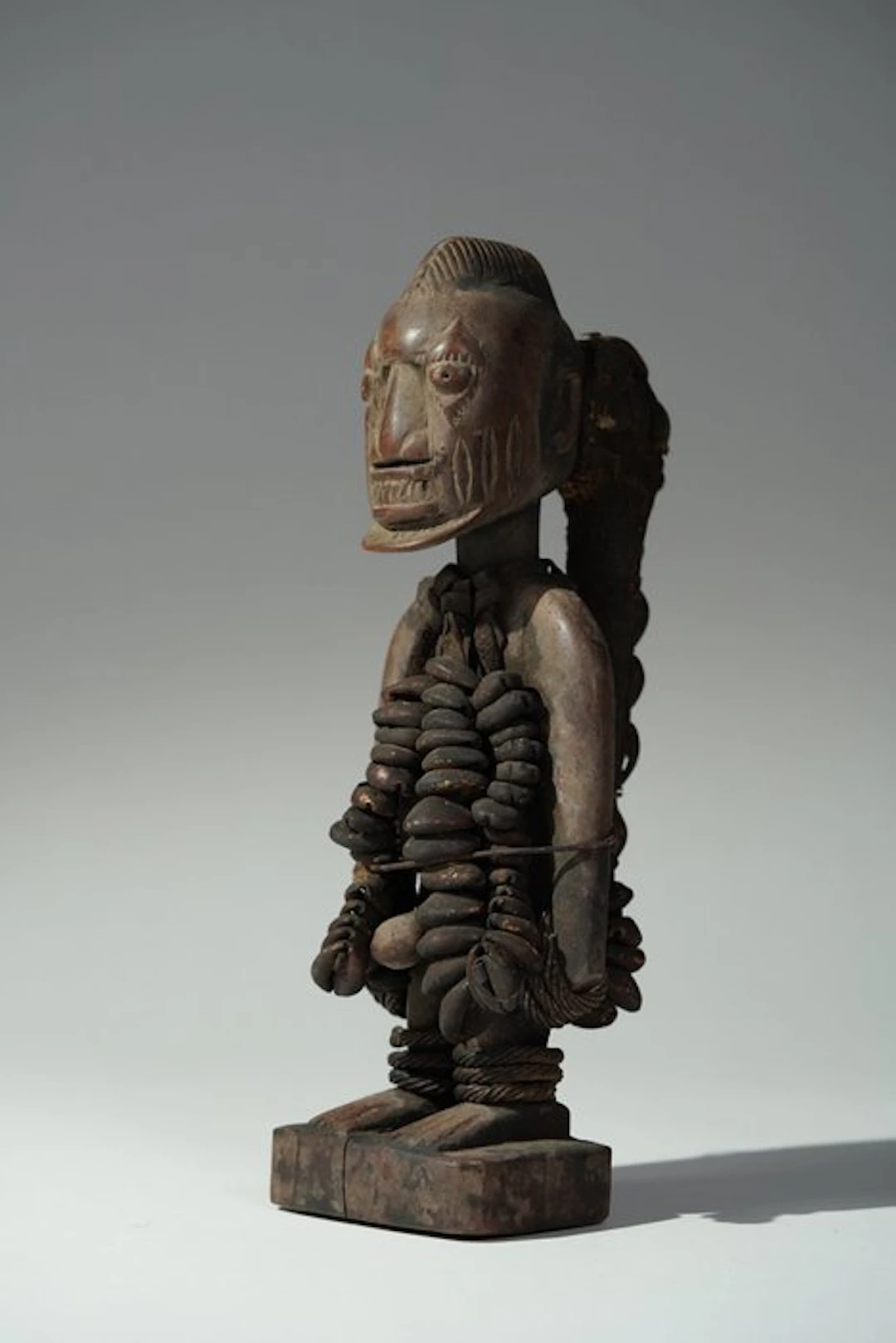
Yoruba Power Figure, Ilorin Region, Nigeria Yoruba, Ilorin region, Nigeria Wood, cowrie shells, fiber, cord and applied ritual materials This imposing Yoruba figure from the Ilorin region is distinguished by the extraordinary accumulation of cowrie shells and other materials covering much of the carved wooden body. The underlying sculpture remains clearly visible in the head, shoulders, arms, hands and feet, while the torso and back have been transformed by dense layers of attachments. The result is an object in which carving and ritual assemblage are inseparable. The head is large in relation to the body and displays a powerful, highly individualized expression. A tall forehead leads to a carefully grooved coiffure. The eyes are prominently modeled and surrounded by sharply defined contours, while the long triangular nose projects strongly from the facial plane. The mouth is indicated by a narrow horizontal opening above a projecting chin. Particularly striking are the deeply incised marks on the cheeks and around the mouth. These parallel and elongated cuts evoke the extensive vocabulary of facial markings historically found among Yoruba communities. Such marks could communicate identity, lineage, locality, status or aesthetic ideals, but their precise significance varies considerably and should not be assigned to a particular subgroup solely from the photograph. The body is comparatively compact. The arms descend vertically at either side, terminating in clenched or strongly abbreviated hands. Both wrists are surrounded by multiple strands of twisted fiber or cord. Similar heavy bindings encircle the ankles immediately above the feet. A further cord passes horizontally across the abdomen and around the figure. Most remarkable is the mass of cowrie shells covering the torso. They are arranged in dense vertical clusters extending from the chest toward the abdomen and continuing around the sides and back. Individual shells remain clearly recognizable, but through repetition they form an almost armor-like second body around the wooden figure. Additional materials are gathered around the neck and behind the head. The rear assemblage rises prominently behind the figure, creating a second vertical mass almost parallel to the back of the head. From the side, this element substantially changes the silhouette and demonstrates that the sculpture was conceived to operate spatially rather than merely frontally. The distinction between carved image and accumulated ritual materials is therefore fundamental to the object's appearance. Cowrie shells possessed considerable economic and symbolic importance in West Africa. They circulated as currency and consequently became closely associated with wealth, value and exchange. Within religious contexts, however, cowries could acquire additional meanings and are particularly familiar from divination equipment, garments, shrine objects and personal regalia. Their presence here should consequently not be reduced to simple decoration. Regional characteristics Ilorin occupies a particularly important position in the cultural geography of Nigeria. Situated at the northern edge of the Yoruba-speaking world, the city developed as a major point of interaction between Yoruba communities and populations connected with the wider Niger and savanna regions. Its artistic traditions consequently reflect a history of cultural exchange rather than an isolated regional style. This position makes the Ilorin attribution especially significant. Yoruba artistic and religious traditions remained important in the region, while the city's historical connections with northern Nigeria introduced additional social and cultural influences. Objects collected around Ilorin therefore deserve to be considered within this complex frontier environment rather than being treated automatically as representative of a generalized Yoruba style. The present figure belongs broadly to the category of empowered ritual objects in which an initially carved sculpture was materially transformed through subsequent additions. Within Yoruba religious practice, the efficacy of an object could depend not simply upon the sculptor's original work but upon substances, attachments, bindings and ritual actions applied after carving. Such additions could fundamentally alter both the appearance and status of the sculpture. The extraordinary concentration of cowries is particularly relevant in this respect. Their multiplication creates a visible statement of abundance and accumulated value. At the same time, the bindings around the wrists, torso and ankles suggest that containment and attachment were integral to the object's conception. In many West African ritual systems, binding can express the fixing, concentrating or controlling of spiritual potency. Nevertheless, the precise meaning of these bindings on this individual figure cannot be established without information about its original shrine context. The facial scarification and elaborate coiffure provide another important layer of identity. Yoruba sculpture often places particular emphasis upon the head, reflecting the wider importance of ori—the head as the locus of individuality, destiny and personal spiritual potential. Here the monumental head remains largely unobstructed by the accumulated materials, ensuring that the figure's identity continues to dominate the composition. The object should not automatically be identified with a specific Yoruba deity such as Eshu, Ogun, Shango or another orisha. Neither the cowries nor the bindings alone provide sufficient evidence for such an attribution. Similarly, identifying the sculpture specifically as a divination figure, ancestor image or protective object would require further documentation. What can be stated more securely is that the sculpture presents an exceptional example of the transformation of a carved human figure through accumulated ritual material. The original wooden body provides the permanent structural core, while cowries, cords and other additions record another dimension of the object's life. Its present appearance is therefore the product not only of a sculptor but also of subsequent acts of attachment and use. Visually, this accumulation produces a compelling opposition. The face is controlled, geometric and clearly legible, whereas the torso becomes dense, irregular and tactile. Smoothly carved limbs emerge from an almost organic mass of shells and bindings. The result is a sculpture whose physical complexity conveys an impression of concentrated potency particularly appropriate to the ritual arts of the wider Yoruba cultural sphere. Selected Literature Drewal, Henry John, John Pemberton III and Rowland Abiodun. Yoruba: Nine Centuries of African Art and Thought. New York: Center for African Art, 1989. Fagg, William, and John Pemberton III. Yoruba: Sculpture of West Africa. New York: Alfred A. Knopf, 1982. Abiodun, Rowland. Yoruba Art and Language: Seeking the African in African Art. Cambridge: Cambridge University Press, 2014. Thompson, Robert Farris. Black Gods and Kings: Yoruba Art at UCLA. Bloomington: Indiana University Press, 1971. Drewal, Henry John, and Margaret Thompson Drewal. Gelede: Art and Female Power among the Yoruba. Bloomington: Indiana University Press, 1983. Some of the information and photos are generated by artificial intelligence and is based on published sources from the fields of ethnography, archaeology, and art history documents. All information and photos are protected by copyright. Inv. No. MAZ30855 Informant: Batoure
Schätzpreis:€275
Zur AuktionAlle Objekte ansehen vonCatawikioderEtnografica
Schätzpreis:
€275




Bringen Sie Ihre Auktion zu Sammlern weltweit!
Jetzt eintragen lassenMit der Anmeldung stimmen Sie der Datenschutzrichtlinie zu. Jederzeit abmelden.
Barnebys HQ
Brahegatan 10
BOX 5038
114 37 Stockholm
