







Alle Auktionen / Etnografica / Authentic Pleistocene Fossilized Forelimb of an Ancient...

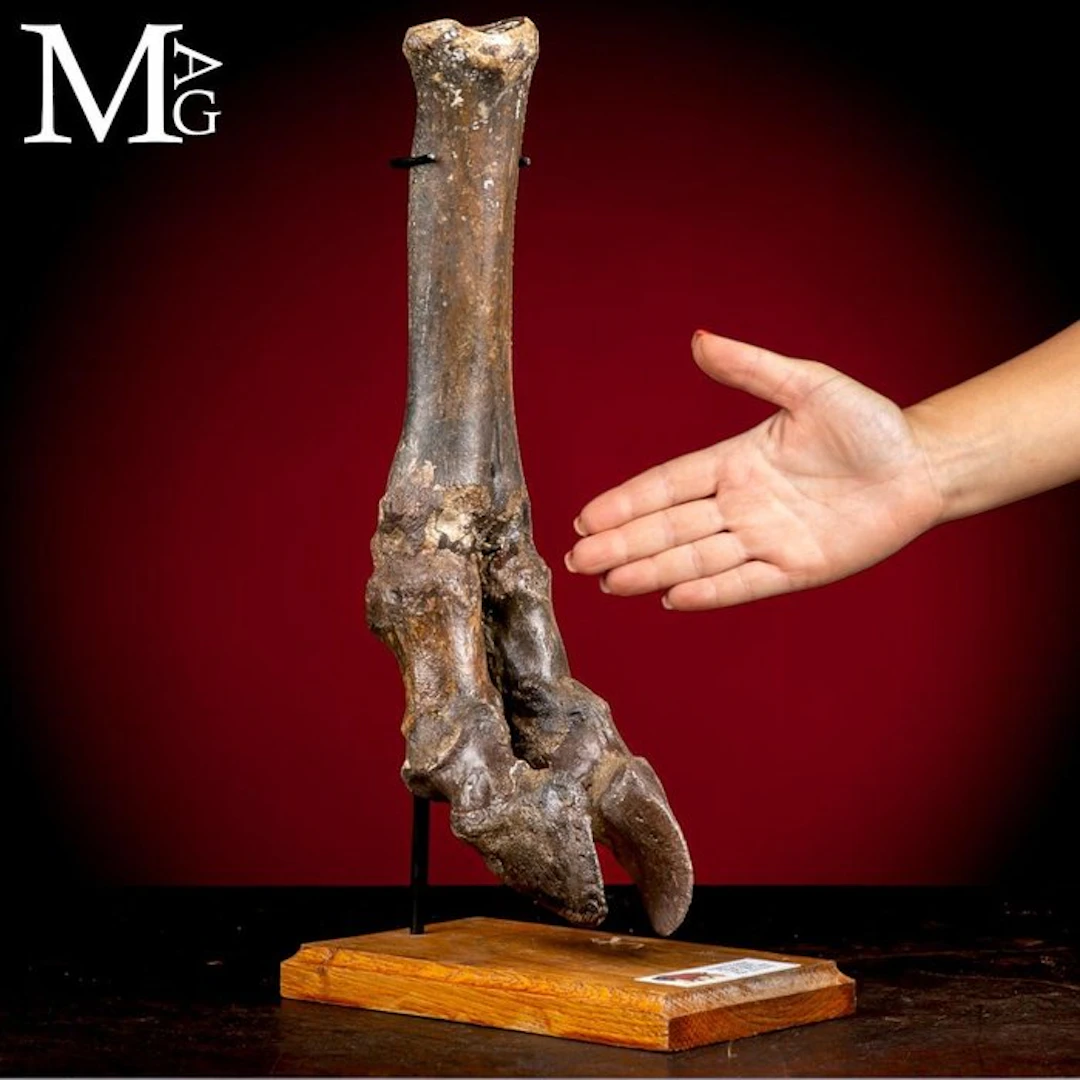
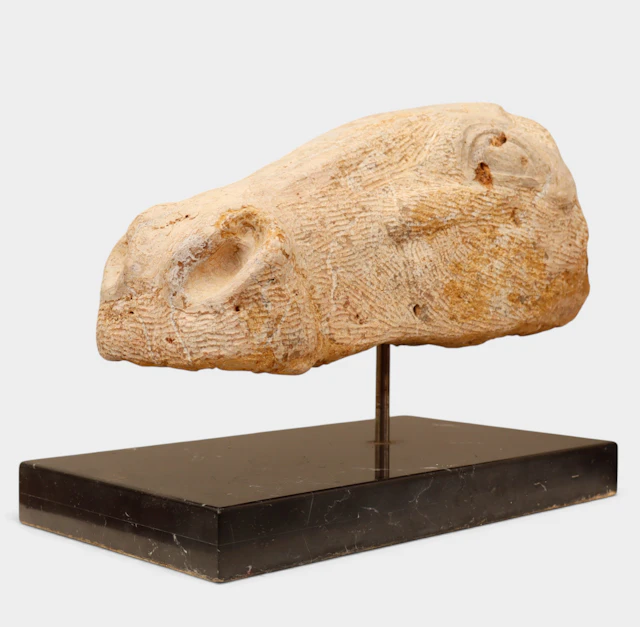
Fossil specimen with a well-preserved distal forelimb comprising the metatarsus, phalanges, and ungual horns (hoof), 100,000 years old — This exceptional paleontological find represents the distal part of the anterior limb of a *Bison priscus* specimen, also known as steppe bison, an extinct species that dominated the vast Eurasian steppes during the Pleistocene. Osteological analysis reveals the presence of the metatarsus, phalanges, and ungual horns (hooves), providing tangible evidence of the anatomy and robustness of these imposing prehistoric mammals. Fossilization has effected deep mineral substitution, preserving the bone structure with remarkable integrity. Visually, the fossil displays a dark, uniform coloration, a hue frequently observed in finds extracted from marine sediments or turbid deposits, indicative of advanced mineralization and prolonged anoxic burial. The bony surfaces retain anatomical details of the joints and muscle insertions, while the ungual horns, though showing signs of slight superficial abrasion, are clearly recognizable, attesting to the authenticity and morphological completeness of the piece. The absence of significant macroscopic fractures and the structural compactness denote an excellent state of preservation. The provenance of this specimen is specified as the North Sea, a geological area of fundamental importance for Pleistocene fossil finds. The seabed of this region is known to have housed a wide variety of faunal remains, often recovered during dredging or fishing activities. This particular geological setting, influenced by large fluctuations in sea level and the alternation of land and sea, has favored ideal conditions for the preservation of a vast number of animal remains, including those of *Bison priscus*. The estimated age of the specimen, about 100,000 years, places it in a crucial phase of the Late Pleistocene. Such a chronological placement provides significant information on megafauna evolution and prehistoric environmental conditions. The robust morphology of the bones and the structure of the ungual horns indicate an animal well adapted to open environments, characterized by extensive grasslands, and a climate alternating between cold and temperate phases. The specimen is elegantly presented on a wooden base with a black metal support, specifically configured to ensure stability and allow optimal observation from every angle. This display arrangement enhances the fossil’s aesthetics, making it readily suitable for inclusion in a museum or private collection. A small identification tag, partially visible, confirms the species, geological period, and geographic origin, contributing to the scientific rigor of the specimen. For the paleontology enthusiast and fossil collector, a specimen of this completeness and in such a state of preservation represents a notably valuable scientific, educational, and aesthetic acquisition. *Bison priscus* remains, particularly those that include distal limb parts with intact hooves, are considered rare on the market and highly sought after for their ability to vividly evoke the majesty of prehistoric fauna and for their invaluable contribution to understanding paleobiodiversity.
Schätzpreis:€500
Zur AuktionAlle Objekte ansehen vonCatawikioderEtnografica
Schätzpreis:
€500




Bringen Sie Ihre Auktion zu Sammlern weltweit!
Jetzt eintragen lassenMit der Anmeldung stimmen Sie der Datenschutzrichtlinie zu. Jederzeit abmelden.
Barnebys HQ
Brahegatan 10
BOX 5038
114 37 Stockholm
