



Alle Auktionen / Etnografica / Chinese Qing Gilt Wood Zao Shen, Chinese Kitchen God

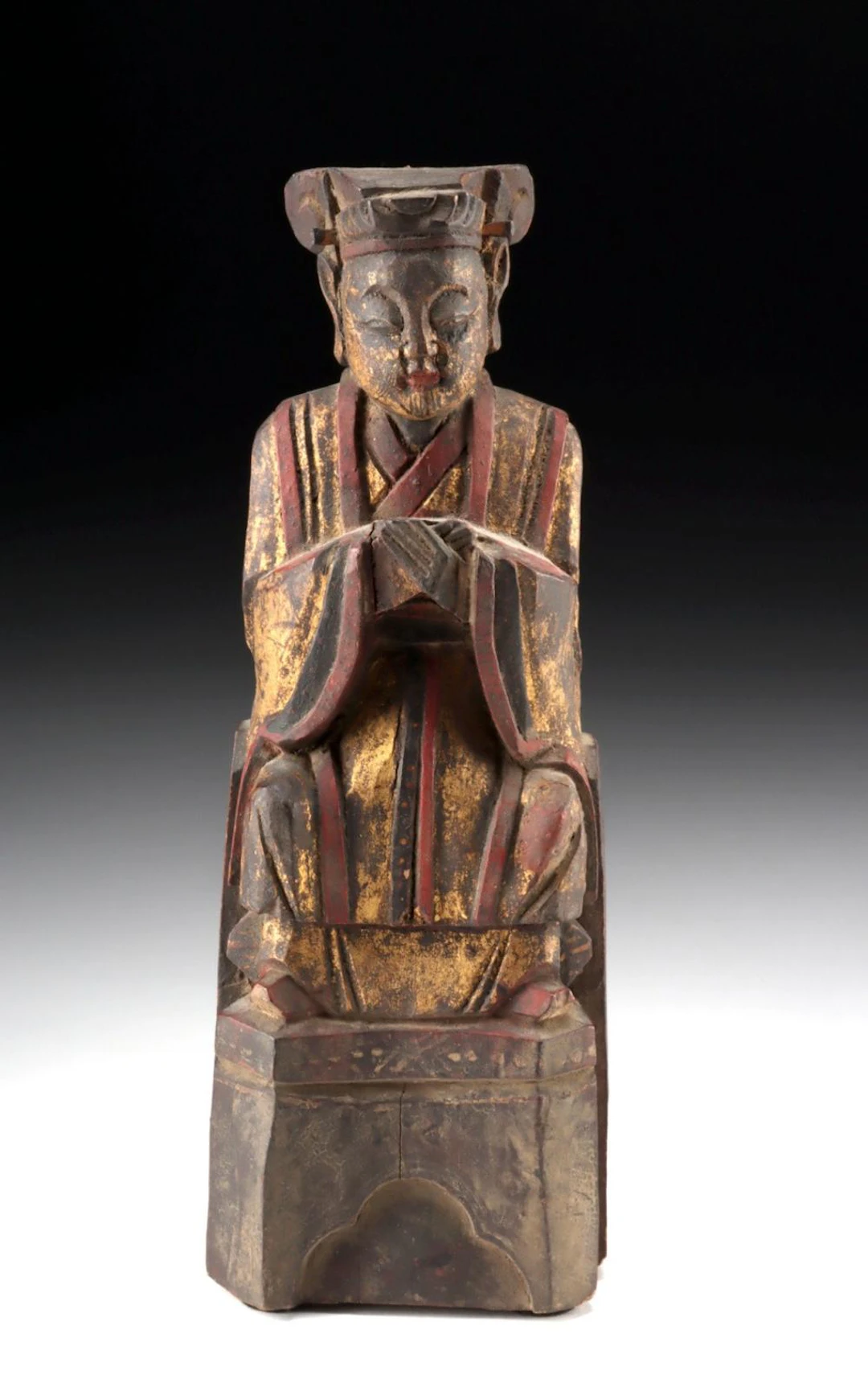
East Asia, China, Qing Dynasty, ca. 18th to 19th century CE. Taoism and Chinese Popular Folk Religion embrace the belief that the cosmos consists of three domains: heaven or the celestial domain, earth, and the underworld, with each realm being inhabited by a constellation of significant gods and goddesses. The celestial domain, headed by the Jade Emperor the Ruler of Heaven has a network of local ministers who preside over earth. The earthly domain hosts deities who have the most frequent and intimate interactions with individuals, family units, and local communities that affect human lives in a variety of ways. Although there are many local house gods, it is the Kitchen God, also known as the Stove God or Hearth God (Zao Shen, Tsao Chun, Zao Jun, Zaojun, and Zaowang) who has been the most revered and ubiquitous household deity since late Ming (1368-1644CE) and Qing (1644-1912) dynasties up through current times. Size: 3.5" W x 9.5" H (8.9 cm x 24.1 cm); gold quality: 16% to 18% Almost every urban or rural family from those living in the emperor’s palace to the most humble of dwellings had and often still has its own Kitchen God who is responsible for observing the family’s behaviour, protecting its wellbeing, and defending against adversity. As the family guardian in charge of its destiny, the family’s personal Kitchen God presides over the family health, secures family harmony, and is its link with other important gods in the Heavenly domain, especially the Jade Emperor for whom he is the deity’s domestic representative. The Kitchen God reports on families’ behavior and morality annually, and has the power to bestow poverty or prosperity, health or sickness, and blessings or misfortune on those families. The Kitchen God Zao Shen is a “tutelary” deity, a guardian or protector of the home and its inhabitants. His placement above or next to the stove attests to his importance in every family’s life, as the kitchen and stove symbolize the importance of family unity. Sometimes Zao Shen is accompanied by his wife, also referred to as his consort. He is responsible for constantly observing the family’s behavior and morality, and he ascends to the heavens to report on them to the Jade Emperor, also known as the Lord or Ruler of Heaven (T’ien Kung or T’ien Wang). While the Kitchen God is away, his wife undertakes his responsibilities in his absence. Some believe that the Kitchen God leaves his earthly home in the family kitchen monthly to relate what he has observed to the city’s spiritual magistrate the City God Cheng Huang and provides his annual report to the Jade God on Chinese Lunar New Year. Obviously, this is the most auspicious time for propitiating and making offerings to him, and the week before then is hence known as the Kitchen God Day. Several weeks before the beginning of the New Year, the entire home as well as the images of Kitchen God himself must be thoroughly cleaned to purify them and create a new and fresh beginning to enable blessings to flow. Depending on the family’s financial resources and traditions, the Kitchen God is depicted in paintings, drawings, paper cuts, wood plaques, and, less frequently, carved wood statues placed above or near the fireplace, stove, or hearth. He may be prominently kept in a shrine that reflects the families’ wealth, and it may be made of masonry, wood, bamboo, or, in more modest homes, a shelf or niche dug into the wall forming a simple altar. He is often depicted along with his wife wearing elaborate official’s robes and hat and grasping a pointed hu tablet similar to the tablets held by high officials in the Chinese court. Hu tablets historically were used as a scepter as well as a writing surface for notes taken at formal presentations at court to record the emperor’s commands and wishes and were continued to be carried as a sign of high rank until the end of the Ming dynasty. Taoist priests or officials also held them at or just below the chest during any spiritual audiences with Taoist deities. This is appropriate as the Kitchen God is said to contain notes about the families’ behavior to be presented during their reports to the Jade Emperor, and he certainly would be expected to hold a hu tablet during his reports to one of the most important deities in the Taoist pantheon. The area in front of where the Kitchen God is displayed must be large enough to accommodate propitiating offerings, reparations for misdeeds, and as entreaties for good fortune. As China is a patriarchal society, women traditionally prepare offerings, while the male head of the family performs the offering ceremony. They are made before the god departs to heaven to assist him in his journey and with the hope he will consume the offerings before ascending and reporting to the Jade Emperor on the household’s activities, achievements, diligence, and morality. Offerings range from simple bowls of fruit like tangerines or oranges that symbolize the sweetness of life, to three small Chinese teacups of rice wine, or to elaborate meals of chicken, pork, vegetables, fruit, and wine. The fruits and sweets, especially honey, are provided to entice the Kitchen God to present sweet words, while the wine is offered so that negative reports will be viewed as questionable due to his inebriated state, to cover all bases. After presenting the offerings, the male supplicant lights three sticks of incense placed in a vessel and bows three times towards heaven. When the incense has expired, family members consume and drink the offerings. Weeks before the Chinese New Year, household members cleanse their home and prepare for Zao Shen’s ascent to heaven to visit the Jade Emperor. Homes are cleaned thoroughly and purified to symbolize a fresh beginning and enable blessings to flow. If the family has a Kitchen God statue, it is taken down and cleaned. Paper images of the Kitchen God (and sometimes his wife) are set up near the stove to prepare for his journey to present his report about the family to the Jade Emperor. A favorable report will elicit Jade Emperor’s blessings to bring good fortune, luck, success, health, and continued life while a poor report many result in punishment, misfortune, infirmity, or possible death to family members. To assure a positive report, an offering called nian gao, a lotus root-like sticky cake made of sugar and honey, is spread on Zao Shen’s lips to make difficult for him to speak and to entice him to present a "sweetened" version of his report. The image is then burned to create smoke that rises to heaven and symbolically represents his journey and may also be accompanied by fire crackers to speed the journey. Sometimes spirit money is offered during while the paper images are being burned. Carvings of Kitchen Gods are a wonderful addition to any kitchen, since they signify and radiate warmth as guardians of the central part of the house. Although in recent times there has been renewed interest in antique woodcarvings of the Kitchen God, they are very difficult to find. When Jennifer Thomas, an American living in Hong Kong, searched in vain throughout China for wood and ceramic representations of Zao Jun, she ultimately located a ceramic company in Guangzhou that had retained kitchen god molds and had them made again. Jennifer now offers them online to pass on this vibrant tradition on her web site Western Chopsticks. Item # 192352
Schätzpreis:€133.72
Zur AuktionAlle Objekte ansehen vonArtemis Fine ArtsoderEtnografica
Schätzpreis:
€133.72
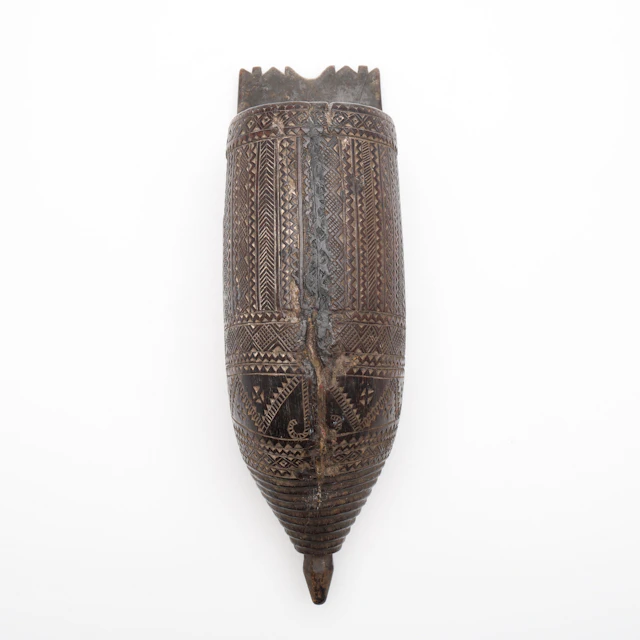
KOGER/BEHÅLLARE, TONGAÖARNA, DATERAD 1938.
10/24/2026
€134.7
Schätzw.: €71.9




Bringen Sie Ihre Auktion zu Sammlern weltweit!
Jetzt eintragen lassenMit der Anmeldung stimmen Sie der Datenschutzrichtlinie zu. Jederzeit abmelden.
Barnebys HQ
Brahegatan 10
BOX 5038
114 37 Stockholm
