


Bringen Sie Ihre Auktion zu Sammlern weltweit!
Jetzt eintragen lassenMit der Anmeldung stimmen Sie der Datenschutzrichtlinie zu. Jederzeit abmelden.
Barnebys HQ
Brahegatan 10
BOX 5038
114 37 Stockholm
Alle Auktionen / Antike Kunst / Egypt – Late Roman / Byzantine-Coptic Period Bone Bone...

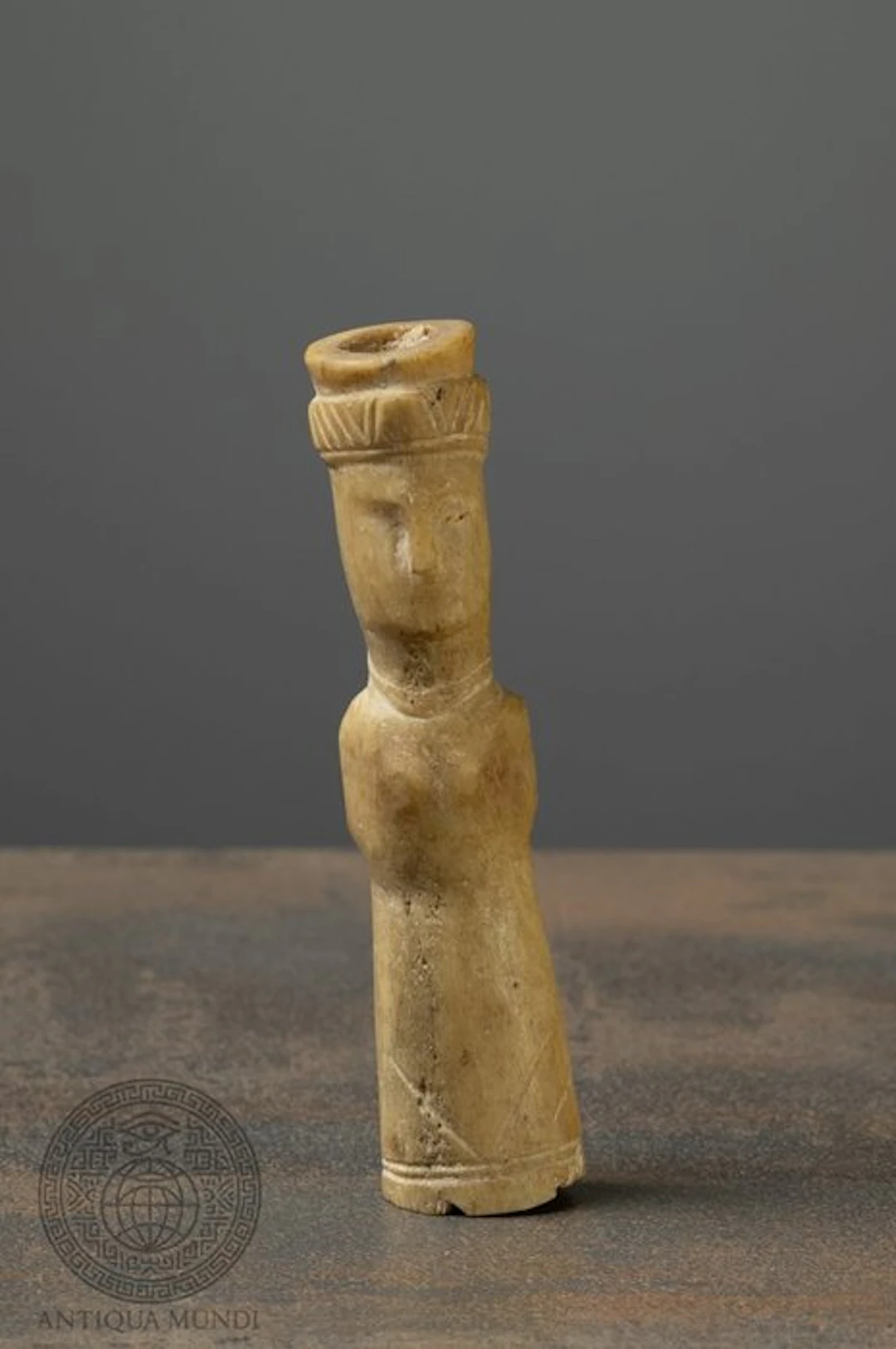
Rare anthropomorphic figure carved from bone, belonging to the distinctive group of ancient Egyptian figures conventionally known as “Coptic dolls.” The figure has a strongly elongated and highly stylised body with a narrow neck, slightly broadened shoulders and an almost columnar lower body. The front is carefully worked, while the reverse is comparatively plain and largely undecorated. The elongated face is carved directly from the bone and displays a prominently projecting nose, subtly indicated eyes and a small incised mouth. The deliberately simplified and abstract modelling is characteristic of related Late Antique Egyptian bone figures. Headdress / Hairstyle The upper part of the head is surrounded by a broad band decorated with a sequence of diagonal incisions, possibly representing a stylised hairstyle, hairband or headdress. A larger opening is visible at the top of the head. This appears to correspond at least partly to the natural internal cavity of the bone used to manufacture the figure rather than necessarily representing later damage. Attachment for Movable Arms Particularly interesting are the two vertically arranged holes at the side of the shoulder area. These probably served for the attachment of separately manufactured arms. Related Egyptian bone dolls are known with articulated or separately attached limbs, which could originally have been connected to the body using cord or another fastening material. The original arms of the present figure are no longer preserved. The lower body is schematically rendered and decorated with fine incised linear ornament. Two parallel horizontal grooves are visible towards the lower end. Function and Cultural Context Anthropomorphic bone figures of this type are traditionally referred to as Coptic dolls in archaeological and museum collections. The term is primarily typological. Related bone figures are known from Late Roman, Byzantine and Coptic Egypt, with the tradition apparently continuing into later periods. Their precise function remains a matter of interpretation. Figures of this type have commonly been interpreted as dolls or toys, although symbolic, ritual or magical functions have also been discussed for related anthropomorphic figures. Museum Comparison A related Egyptian carved bone doll is preserved in the Michael C. Carlos Museum, Emory University, and is catalogued as Doll in the Form of a Nude Woman, dated to the 5th century AD. Museum reference: https://collections.carlos.emory.edu/objects/38681/doll This museum example provides a useful typological comparison; it is not intended to establish an identical date for the present figure. Material and Surface Carved from a naturally hollow section of bone and subsequently smoothed and polished. The material displays an attractive beige to honey-brown age patina, with darker areas of discolouration and deposits. The natural structure of the bone remains clearly visible in several areas. The openings at the upper and lower ends reveal the natural internal cavity of the bone from which the figure was made. Condition Age-related state of preservation. Surface wear, minor scratches, deposits, discolouration and small chips are present. The separately manufactured arms are no longer preserved; the original lateral attachment holes remain visible. There is a small loss at the lower end. Despite the age-related wear, the facial features, incised decoration, headdress or hairstyle and overall anthropomorphic form remain clearly recognizable. Provenance: Formerly in the Madeleine & Erich Dammann Collection, Germany. Acquired during the collectors’ extensive travels between 1950 and 1970. The collection is documented in Germany by 1970 through historical photographs of the family residence and subsequently remained in continuous family ownership. The objects were acquired privately during the collectors’ travels. As was customary for private purchases made at local markets during the 1950s and 1960s, purchase receipts or invoices were generally neither issued nor requested. Historical photographs and biographical documentation relating to the Dammann Collection are available and support the long-standing provenance of the collection.
Schätzpreis:€450
Zur AuktionAlle Objekte ansehen vonCatawikioderAntike Kunst
Schätzpreis:
€450
EGYPTIAN BRONZE INLAID APPLIQUE OF URAEUS - MUSEUM EXHIBITED
06/21/2026

€1,623.13
Schätzw.: €1,154.78



Bringen Sie Ihre Auktion zu Sammlern weltweit!
Jetzt eintragen lassen€275