




OCT 27 | 4:00 PM

Alle Auktionen / Schmuck und Edelsteine / Large Antique Shell Cameo After John Gibson in Gold, c. 1875

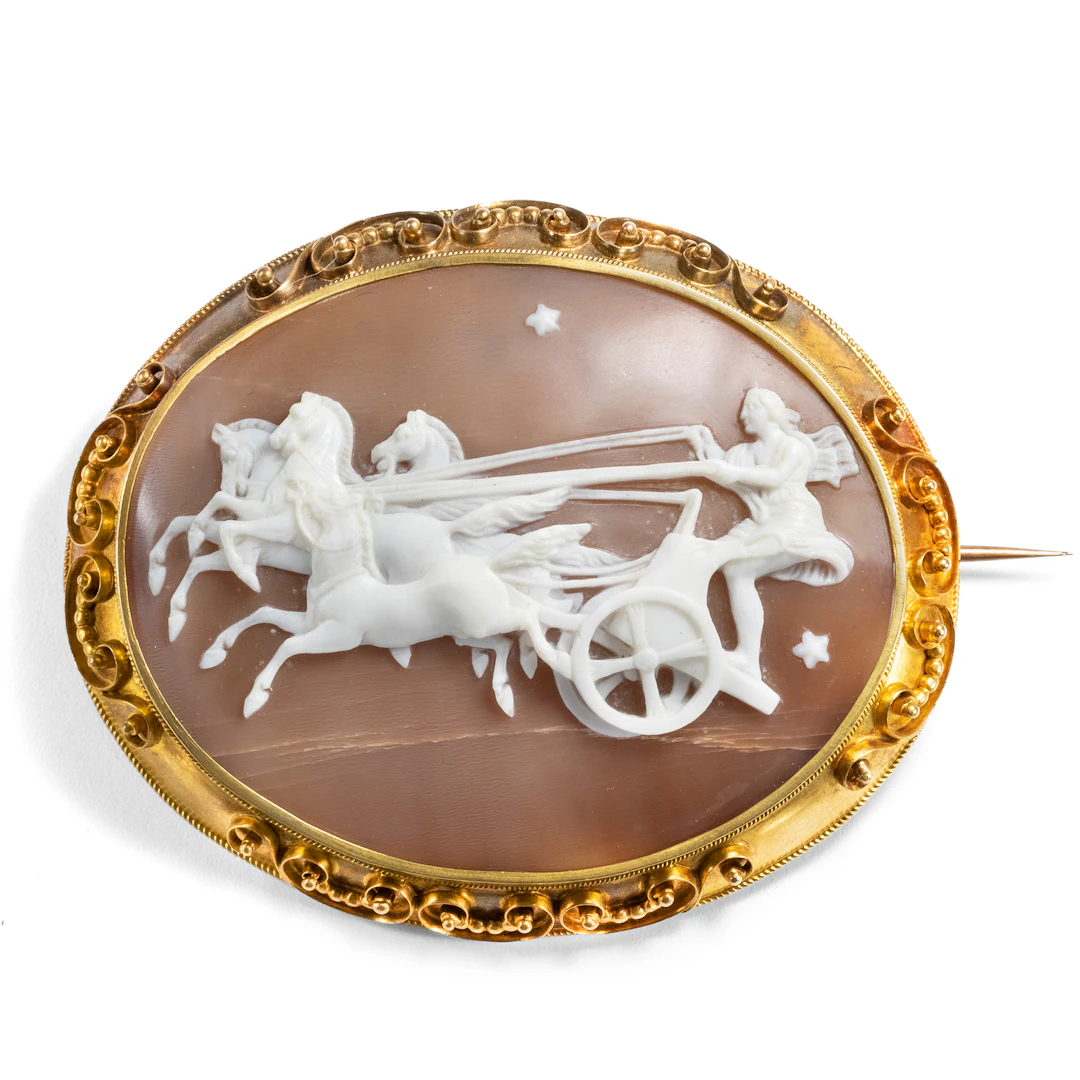
It is the gruesome end of such a courageous wish. Phaeton, the son of the sun god Helios, longed for nothing so much as to one day drive his father's chariot across the firmament. The loving father was worried and suspected disaster, but nevertheless granted his son his wish. What a mistake! For the chariot spun out of control, the sun reeled, setting cities on fire and shattering mountains. The world was on the brink of destruction. Only a thunderbolt from Zeus prevented even worse - but it killed the son. Phaeton plummets to earth and falls into the river Eridanus. His lover, King Cyknos, rushes to him, weeping and singing heart-rending lamentations. Out of pity, Apollo transforms him into a swan, then into the constellation in the sky, and Phaeton's weeping sisters into poplars that rustle forever in the wind. This brooch shows Phaeton in a sun chariot. The pictorial invention goes back to John Gibson, a Welsh sculptor of classicism who worked in the wake of Canova and Thorwaldsen and enjoyed great success in Great Britain in the middle of the 19th century. He created two large reliefs in the years around 1850, The Hours leading the Horses of the Sun and Phaeton driving the Chariot of the Sun. The plaster reliefs are in the collection of the Royal Academy in London, and there are several examples in marble. The scene with Phaeton, driven by arrogance, trying to steer the chariot of the sun and failing, was a great success for Gibson. It was almost immediately translated into the medium of the shell cameo by Tommaso Saulini, the most famous gem cutter of the mid-19th century, and was presented at the Great Exhibition in London in 1851. The cameo has survived and is now in the British Museum. This gem was probably created only a little later. The golden frame is decorated with fine gold wires and beads in the Etruscan Revival style, which was popular in the jewellery world in the 1870s. This makes it easy to date this piece of jewellery, which came to us from Great Britain. On the scene and the cameo in the British Museum cf. Charlotte Gere/Judy Rudoe: Jewellery in the Age of Queen Victoria, London: British Museum Press 2010, S. 474-475.
Schätzpreis:€1,790
Zur AuktionAlle Objekte ansehen vonHofer AntikschmuckoderSchmuck und Edelsteine
Schätzpreis:
€1,790
OCT 27 | 4:00 PM




Bringen Sie Ihre Auktion zu Sammlern weltweit!
Jetzt eintragen lassenMit der Anmeldung stimmen Sie der Datenschutzrichtlinie zu. Jederzeit abmelden.
Barnebys HQ
Brahegatan 10
BOX 5038
114 37 Stockholm
