




OCT 27 | 4:00 PM

Alle Auktionen / Schmuck und Edelsteine / Pendant with an Ancient Egyptian Seal Amulet in Gold, c. 1000 B.C. and c. 1890

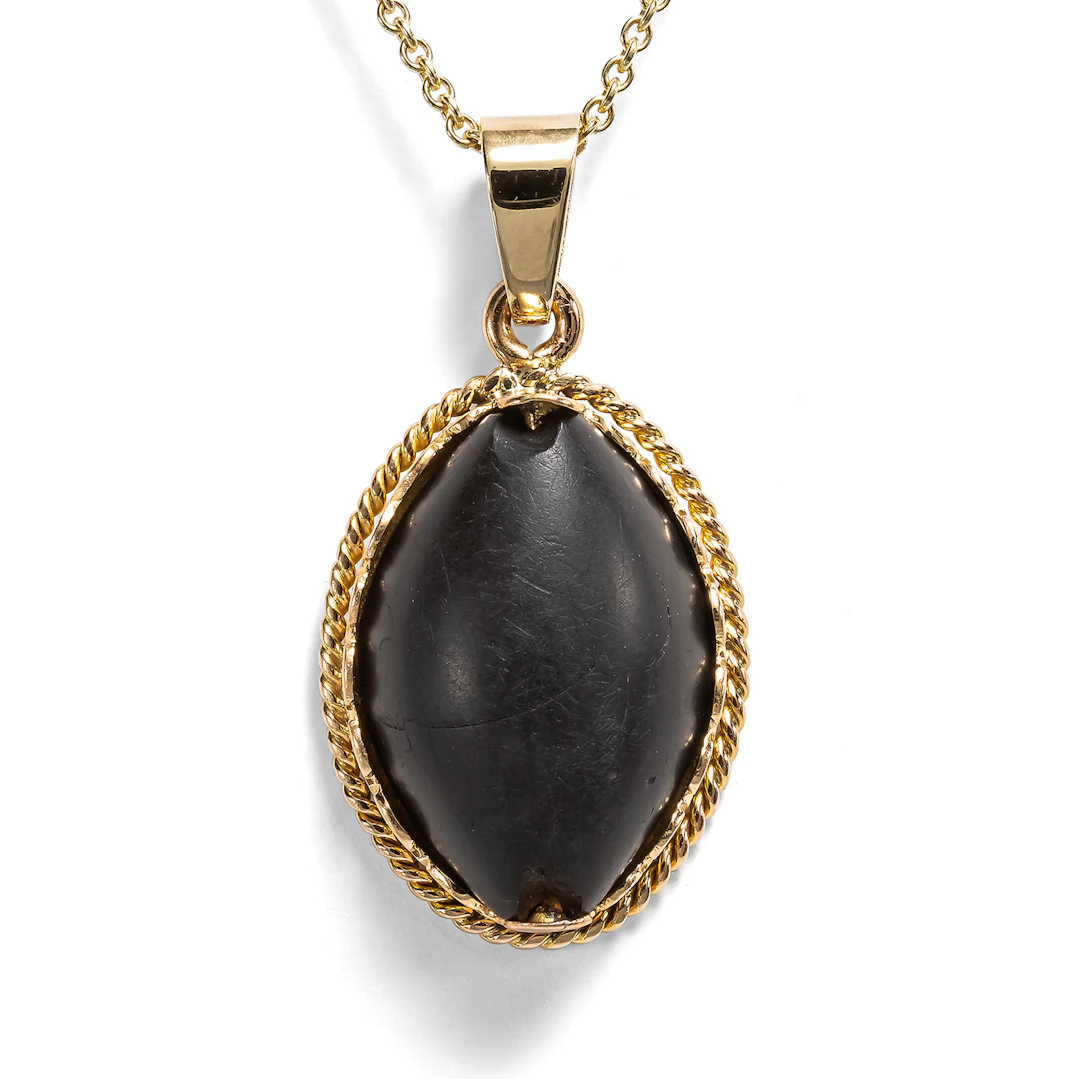
Small seals and amulets were part of daily life in Ancient Egypt for many centuries. Scarabs were particularly common; their flat undersides were inscribed with names, hieroglyphs, or images. These small objects were usually pierced lengthwise, allowing them to be worn on a cord or set into a ring so they could rotate. They combined practical and magical functions: the engraved underside could serve as a seal, while the amulet was also intended to grant protection to its wearer. This small seal amulet also belongs to this tradition. It is carved from black stone and has a simple, smoothly domed upper surface. Unlike a scarab, it lacks the characteristic features of a beetle’s body. A longitudinal hole originally allowed the stone to be strung and worn on the body. The true significance of the amulet is revealed on its underside. Here, a fish—likely a Nile tilapia—is carved with just a few bold lines. This motif was by no means unusual in Ancient Egypt. The tilapia also appears as the hieroglyph K1 in the Gardiner List Gardiner K1 and appears repeatedly, especially on seal amulets from the New Kingdom, either alone or together with plants and other symbols. A remarkably similar example from the early 18th Dynasty is housed at the Metropolitan Museum in New York. There, too, a small seal amulet bears a tilapia on its underside. The fish also held special symbolic significance. The tilapia was regarded as a symbol of fertility, renewal, and rebirth. This notion is associated with its striking breeding behavior. Tilapias are mouthbrooders, meaning the young fish emerge from the parent’s mouth. This apparent creation of new life made the fish a fitting symbol of regeneration. On a scarab from the time of Hatshepsut and Thutmose III, tilapia and lotus appear together. The Metropolitan Museum explicitly interprets both as symbols of rebirth. Our small seal amulet likely originated in the New Kingdom or possibly even in the Late Period. A more precise dating is difficult to establish without a confirmed context of discovery. However, comparable depictions of fish are particularly good for the New Kingdom. The gold setting, dating from around 1890, ultimately transformed the ancient Egyptian amulet into a pendant, thereby preserving an object that had already been intended for wear in antiquity. We have paired this piece, which came to us from the Hamburg art trade, with a matching gold chain.
Schätzpreis:€1,290
Zur AuktionAlle Objekte ansehen vonHofer AntikschmuckoderSchmuck und Edelsteine
Schätzpreis:
€1,290
OCT 27 | 4:00 PM




Bringen Sie Ihre Auktion zu Sammlern weltweit!
Jetzt eintragen lassenMit der Anmeldung stimmen Sie der Datenschutzrichtlinie zu. Jederzeit abmelden.
Barnebys HQ
Brahegatan 10
BOX 5038
114 37 Stockholm
