
Bringen Sie Ihre Auktion zu Sammlern weltweit!
Jetzt eintragen lassenMit der Anmeldung stimmen Sie der Datenschutzrichtlinie zu. Jederzeit abmelden.
Barnebys HQ
Brahegatan 10
BOX 5038
114 37 Stockholm
Alle Auktionen / Musik & Musikinstrumente / Philips - Bi- Ampli - Stereo with FM Tube radio

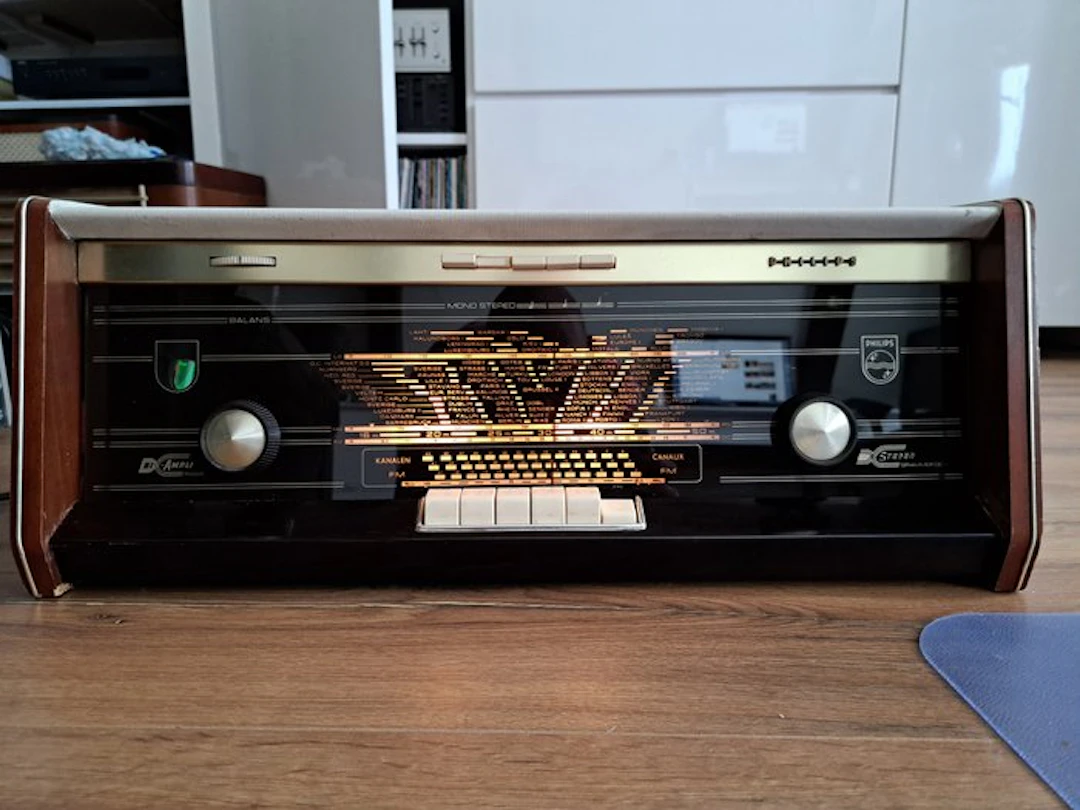
Please read the underneath carefully for a good understanding of what this model offers. Here are some remarks about the radio in auction - The magic eye is bright and is clearly visible even in daylight conditions - One of the tube sockets for the EL84 has been replaced as it was making bad contacts - Some elco's have been replaced - reception is good on all bands, but the long wave was tested with equipment as there are no broadcasts anymore on long wave (and sparsely on medium wave. - On the switch assembly for the sound, the middle of the three tone adjustments is broken and cannot be used. I have fixed the knob but it should not be used. - the top cover is reasonably clean (see photo) but appears to be painted again - the bass reproduction is not really strong in my experience (see below for explanation). ChatGPT tells me the following about this model: The Philips B5X04A is a particularly interesting Philips tube radio from around 1960–1961. It is part of Philips' late-generation Bi-Ampli radios and is considerably more sophisticated than an ordinary mono table radio of the period. The "Bi-Ampli" designation is not just marketing. Philips used two separate audio amplifier channels, each built around an EL84 output tube. The amplifier is rated at approximately 2 × 3.5 W, driving the two 800-ohm Philips AD3700AM speakers. The idea was to separate the audio spectrum between two amplifier sections rather than asking one small amplifier to reproduce everything. Philips claimed this reduced interaction between bass and treble and effectively gave more usable output. The B5X04A covers: Long Wave Medium Wave Short Wave FM The FM coverage is 87.5–100 MHz, which is the original European FM range of the period. AM reception uses an internal ferrite antenna, while FM uses an external antenna connection. The short-wave coverage is particularly useful: 5.95–18.2 MHz, so this wasn't merely a local European broadcast receiver. And there is an important stereo distinction This is where the B5X04A can be misunderstood. It has two audio amplifiers and two speakers, and it can reproduce a stereo signal from an external source, such as a record player or tape recorder. However, it does not have stereo FM decoding. In other words, it isn't a stereo FM receiver in the modern sense. That makes the radio rather interesting historically: Philips was providing a genuine two-channel audio system before FM stereo broadcasting had become part of the receiver. The speakers being on the sides is also part of Philips' "Plano" concept. Instead of putting large speakers directly behind the front grille, Philips made the cabinet relatively low and moved the speakers toward the sides. This allowed the large illuminated tuning scale to dominate the front. Why does the Plano radio have not that much bass? 1) Very small, shallow cabinet The Plano concept deliberately made the cabinet relatively thin and wide. That's aesthetically excellent, but it gives the speakers little acoustic volume to work with. A small enclosure rolls off the bass early. 2) Small side-firing speakers The AD3700AM speakers are only about 14 cm. They can produce respectable midrange, but they aren't capable of moving much air at very low frequencies. Their placement at the sides also isn't ideal for strong bass coupling.
Schätzpreis:€6
Zur AuktionAlle Objekte ansehen vonCatawikioderMusik & Musikinstrumente
Schätzpreis:
€6






Bringen Sie Ihre Auktion zu Sammlern weltweit!
Jetzt eintragen lassen
BÖCKER, HÄFTEN M. M.. konstlitteratur, bl. a. Jan Håfström.
09/29/2026

€57.33
Schätzw.: €35.31

LP-SKIVOR OCH SINGLAR, ca 160 stycken, blandade artister, 1970-90-tal.
09/29/2026
€114.66
Schätzw.: €52.97