


Alle Auktionen / Antike Kunst / Western Asiatic Bronze Flanged-Hilt Dagger with...

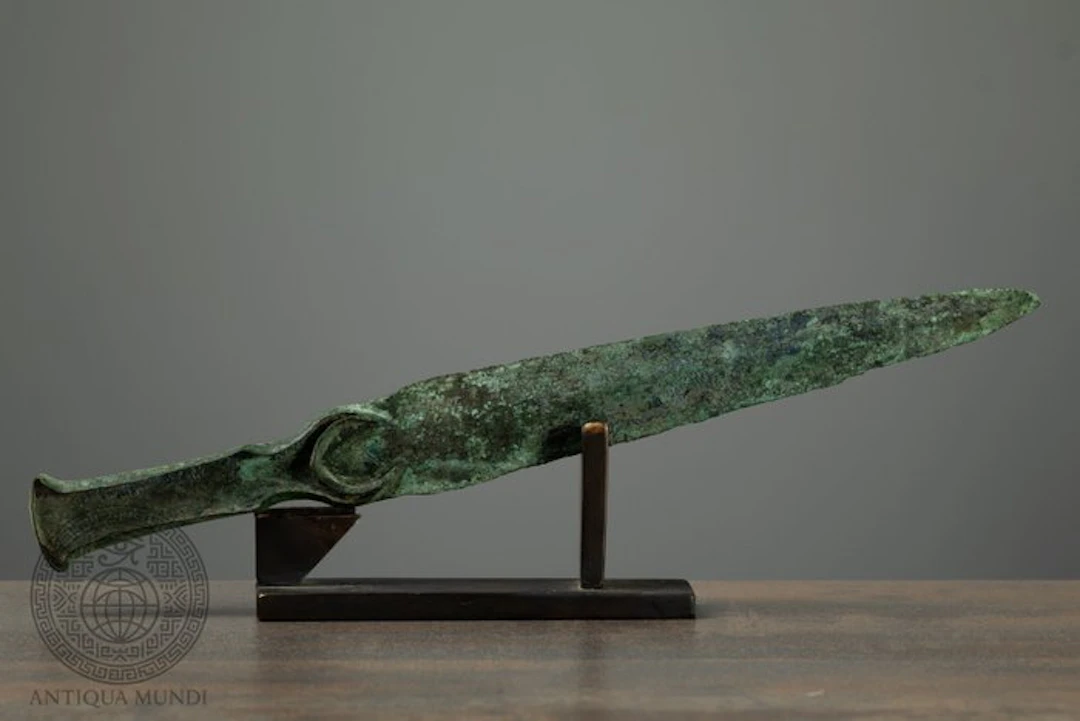
Long and characteristically shaped bronze flanged-hilt dagger from the cultural region of Luristan in Western Iran. The blade and hilt form a continuous bronze construction. The elongated, slender blade tapers evenly towards a rounded point. A subtle longitudinal reinforcement or profiling is visible along the blade. The cutting edges are largely straight and display the age-related irregularities characteristic of an ancient bronze weapon. Particularly noteworthy is the preserved flanged hilt. Its sides are bordered by distinctly raised flanges. This construction was originally designed to accommodate separately made grip inlays of organic material, such as wood or bone. Such inlays are frequently no longer preserved on surviving Luristan daggers. Comparable flanged-hilt daggers in the collection of the Archäologische Staatssammlung München are likewise described as weapons that originally possessed organic grip inlays. At the transition between the hilt and the blade, both sides display a particularly striking crescent- or sickle-shaped relief decoration. The strongly modelled, almost circularly curved relief element visually separates the hilt from the blade and represents the most distinctive decorative feature of the dagger. The end of the hilt broadens considerably and terminates in a transversely projecting, slightly convex T-shaped pommel. Together with the raised lateral flanges, this creates the characteristic construction associated with this group of Western Iranian bronze daggers. An exceptionally close typological comparison is known as a “Luristan flanged-hilt dagger with crescent-shaped decoration.” This comparable example likewise features a long and slender blade, an integral flanged hilt, crescent-shaped relief decoration at the transition to the blade, and a transversely broadened T-shaped pommel. It is dated to approximately 1100–900 BC. Typology and Function Flanged-hilt daggers belong to a characteristic group of Western Iranian bronze weapons. The raised lateral edges of the hilt formed a frame into which grip plates made from perishable organic materials could originally be inserted. Archaeological parallels demonstrate that such handles could have been fitted with plates of wood, bone or similar materials, which are frequently lost due to their organic nature. The Archäologische Staatssammlung München associates this type of dagger with Luristan on the basis of archaeological finds from sites including Tang-i Hamamlan, Kutal-i Gulgul and Bard-e Bal. Research into Luristan weaponry likewise describes bronze daggers with raised lateral hilt flanges and originally inserted grip plates of wood or bone as a characteristic Western Iranian weapon form. Based on the close typological correspondence with documented comparative examples, a dating to Iron Age I, circa 1100–900 BC, is appropriate for the present piece. Condition Age-appropriate good state of preservation. The blade, flanged hilt construction, distinctive crescent-shaped decoration and T-shaped pommel are preserved. The bronze surface displays a pronounced green to dark green patina, with brown and locally blue-green areas as well as mineral deposits and encrustations. There is age-related corrosion, surface roughness and minor irregularities or small losses along the cutting edges. The point is preserved but has become somewhat rounded with age. The original grip inlays that would have been positioned between the raised lateral flanges are no longer present, as is frequently the case with comparable surviving examples. Please examine all photographs carefully, as they form an integral part of the condition description. Included in the Sale The sale includes the ancient bronze dagger only. The modern display stand visible in the photographs is used solely for presentation and is not included in the sale. Provenance Formerly in the Madeleine & Erich Dammann Collection, Germany. Acquired during the collectors’ extensive travels between 1950 and 1970. The collection is documented in Germany by 1970 through historical photographs of the family residence and subsequently remained in continuous family ownership. The objects were acquired privately during the collectors’ travels. As was customary for private purchases made at local markets during the 1950s and 1960s, purchase receipts or invoices were generally neither issued nor requested. Historical photographs and biographical documentation relating to the Dammann Collection are available and support the long-standing provenance of the collection.
Schätzpreis:€900
Zur AuktionAlle Objekte ansehen vonCatawikioderAntike Kunst
Schätzpreis:
€900
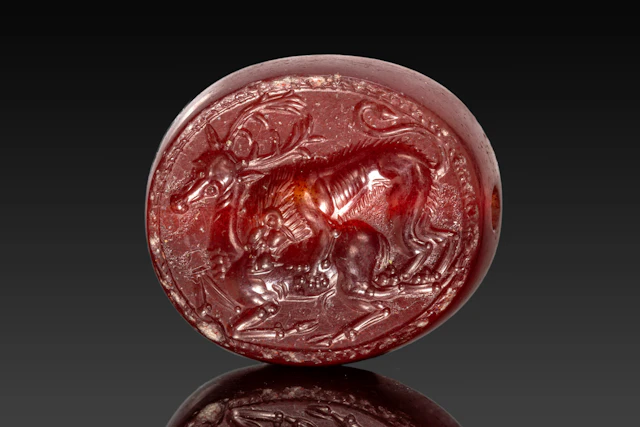
ETRUSCAN CARNELIAN STAMP SEAL WITH A LION ATTACKING A STAG
06/21/2026

€5,796.91
Schätzw.: €5,773.91
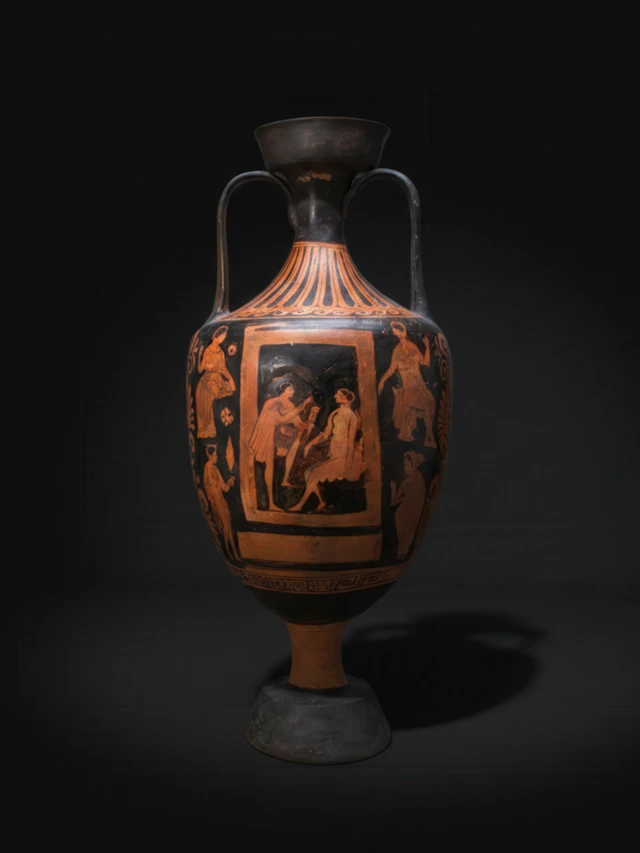
LARGE APULIAN RED-FIGURE AMPHORA WITH NAISKOS SCENE AND ALTAR
06/21/2026
€6,376.6
Schätzw.: €5,773.91




Bringen Sie Ihre Auktion zu Sammlern weltweit!
Jetzt eintragen lassenMit der Anmeldung stimmen Sie der Datenschutzrichtlinie zu. Jederzeit abmelden.
Barnebys HQ
Brahegatan 10
BOX 5038
114 37 Stockholm
